
Inverted microscopes
An inverted microscope places the objectives below the stage and the light source above, letting you observe living cells or organisms at the bottom of a large container, such as a tissue culture flask or Petri dish, under more natural conditions than on a glass slide. This makes it the standard choice whenever a sample needs to stay in its vessel during observation, particularly for live cell imaging in cell biology and IVF laboratories. Optika’s inverted range spans three levels: the IM-300 series for fast, reliable routine inspections, the IM-5 series for flexible research work with the widest field of view in its category, and the IM-7 series, a fully expandable research imaging platform for the most demanding applications.
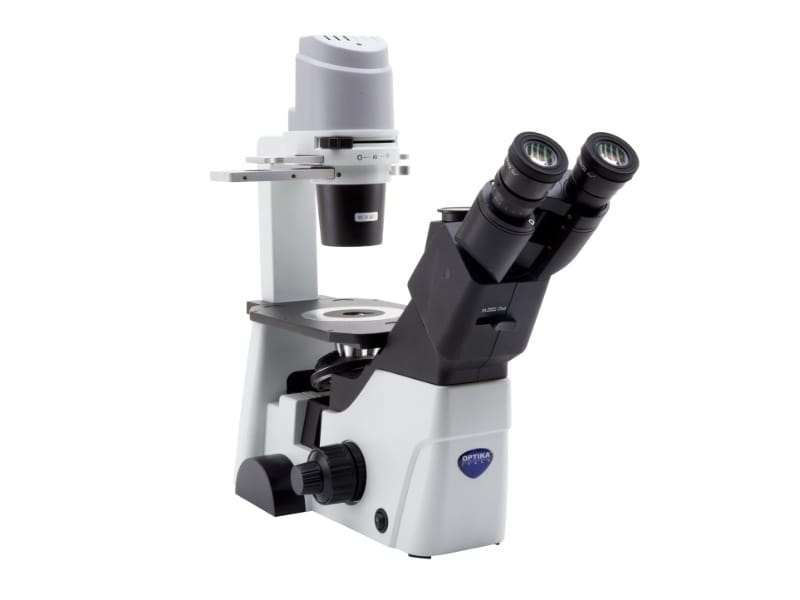
- Type: Inverted brightfield/phase contrast
- Magnification: Up to 400x
- Optics: IOS LWD W-PLAN PH
- Illumination: X-LED8
- Head: Trinocular, 45 degree inclined
€2.754,00 excl. VAT
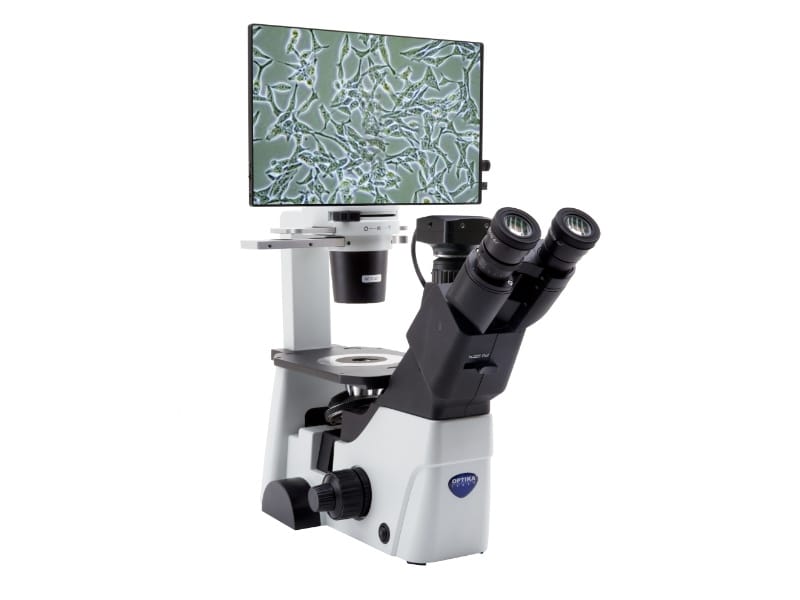
- Type: Inverted brightfield/phase contrast, digital
- Magnification: Up to 400x
- Optics: IOS LWD W-PLAN PH
- Illumination: X-LED8
- Head: Trinocular with 6.3 MP camera
€5.086,00 excl. VAT
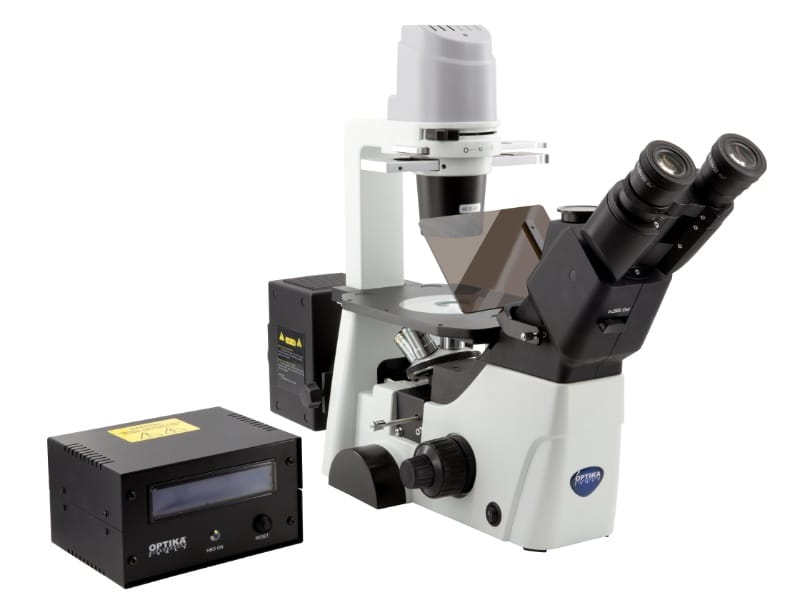
- Type: Inverted HBO fluorescence, trinocular
- Magnification: Up to 400x
- Optics: IOS LWD W-PLAN PH
- Illumination: HBO 100W, X-LED8 transmitted
- Head: Trinocular, 45 degree inclined
€7.544,00 excl. VAT
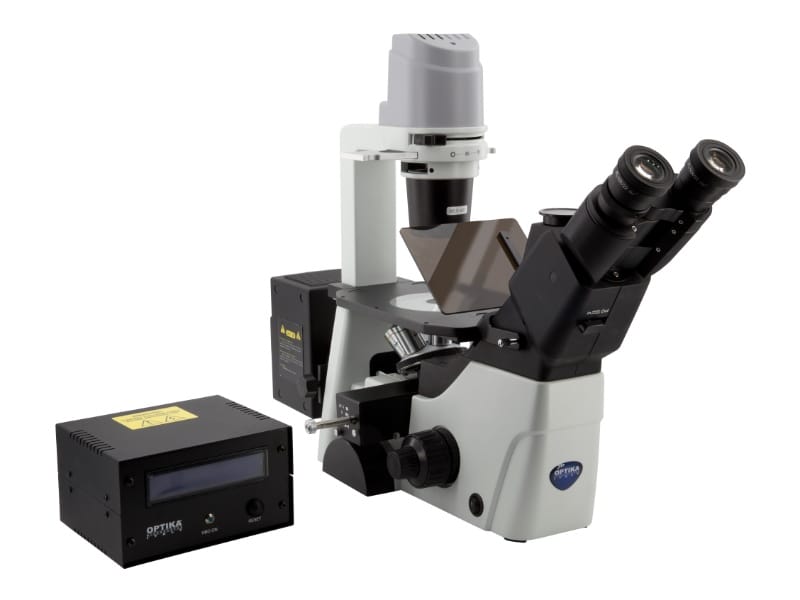
- Type: Inverted HBO fluorescence, trinocular
- Magnification: Up to 400x
- Optics: IOS LWD U-PLAN F
- Illumination: HBO 100W, X-LED8 transmitted
- Head: Trinocular, 45 degree inclined
€10.768,00 excl. VAT
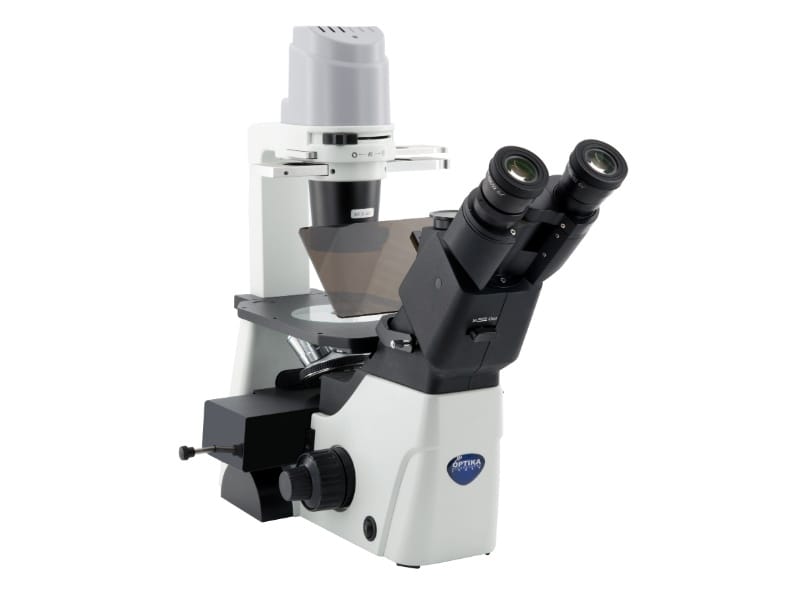
- Type: Inverted LED fluorescence, trinocular
- Magnification: Up to 400x
- Optics: IOS LWD W-PLAN PH
- Illumination: LED Fluorescence Cube, X-LED8 transmitted
- Head: Trinocular, 45 degree inclined
€7.530,00 excl. VAT
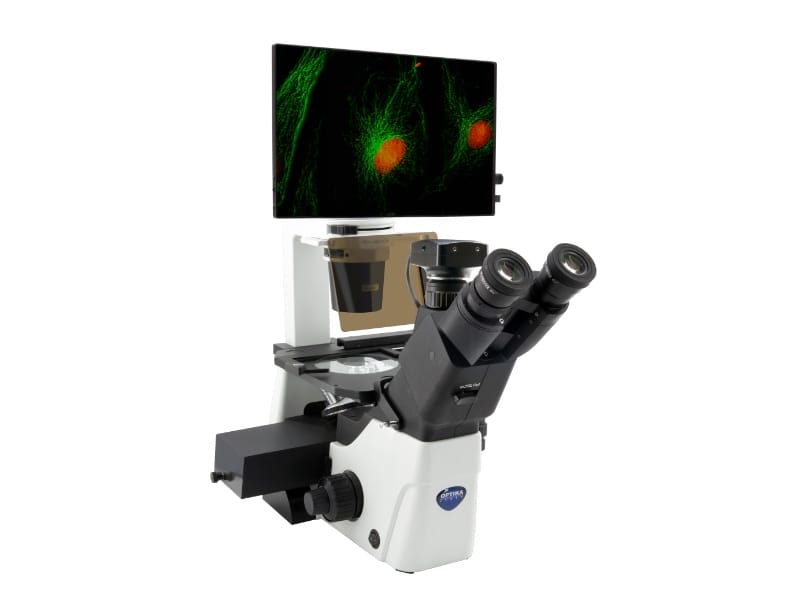
Optika IM-300LD4 Inverted LED fluorescence microscope, 400x, IOS LWD PLAN F, 4 empty filterset slots
- Type: Inverted LED fluorescence, trinocular
- Magnification: Up to 400x
- Optics: IOS LWD U-PLAN F, configurable fluorescence
- Illumination: LED Fluorescence Cube, X-LED8 transmitted
- Head: Trinocular, 45 degree inclined
€8.234,00 excl. VAT
- Type: Inverted LED fluorescence, digital
- Magnification: Up to 400x
- Optics: IOS LWD U-PLAN F, configurable fluorescence
- Illumination: LED Fluorescence Cube, X-LED8 transmitted
- Head: Trinocular with 6.3 MP camera
€10.893,00 excl. VAT
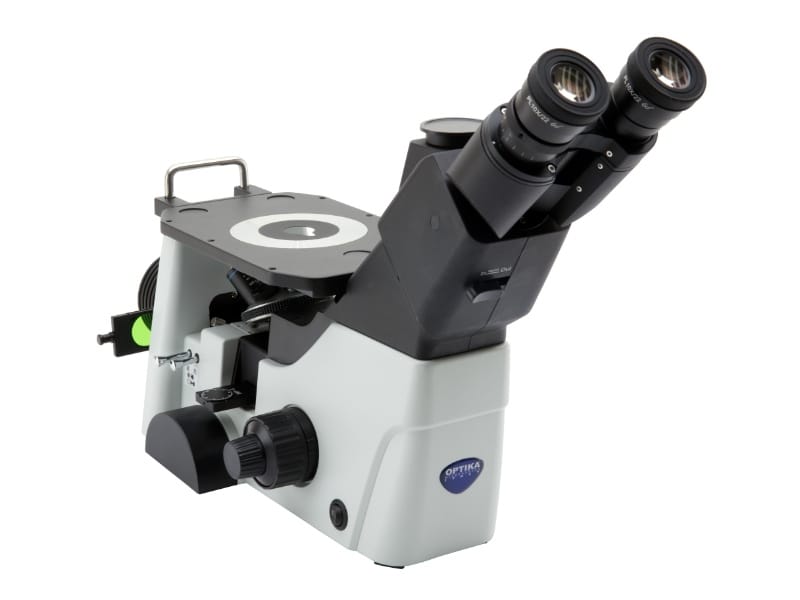
- Type: Inverted metallurgical, trinocular
- Magnification: Up to 500x
- Optics: IOS LWD U-PLAN MET
- Illumination: LED 18W incident
- Head: Trinocular, 45 degree inclined
€2.722,00 excl. VAT
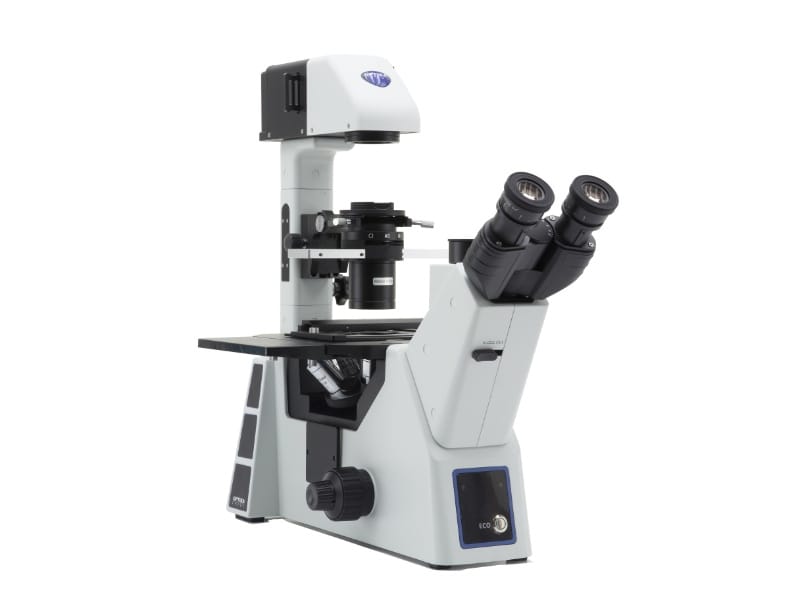
- Type: Inverted brightfield/phase contrast, trinocular
- Magnification: Up to 600x
- Optics: IOS LWD, configurable objective platform
- Illumination: X-LED8 transmitted
- Head: Trinocular, 45 degree inclined
€4.218,00 excl. VAT
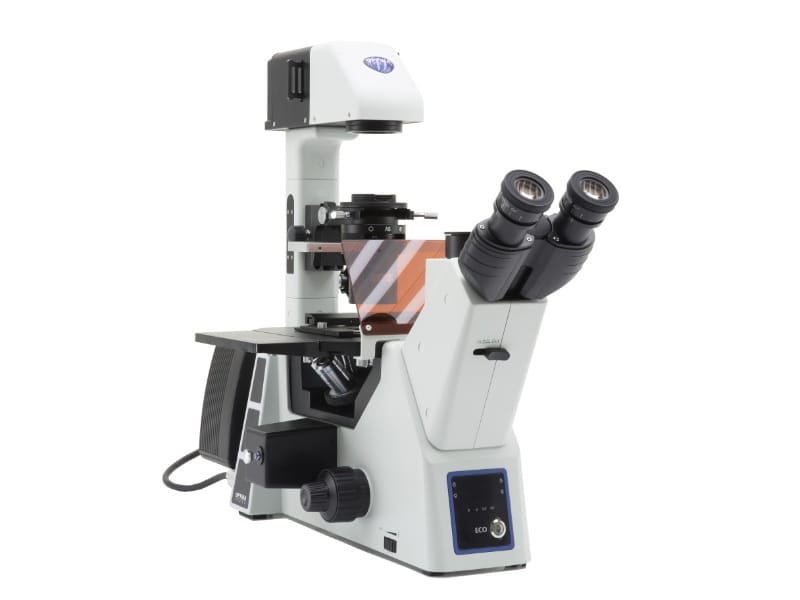
- Type: Inverted LED fluorescence, trinocular
- Magnification: Up to 600x
- Optics: IOS LWD, configurable objective platform
- Illumination: X-LED8 transmitted, B/G/UV fluorescence LEDs
- Head: Trinocular, 45 degree inclined
€10.832,00 excl. VAT
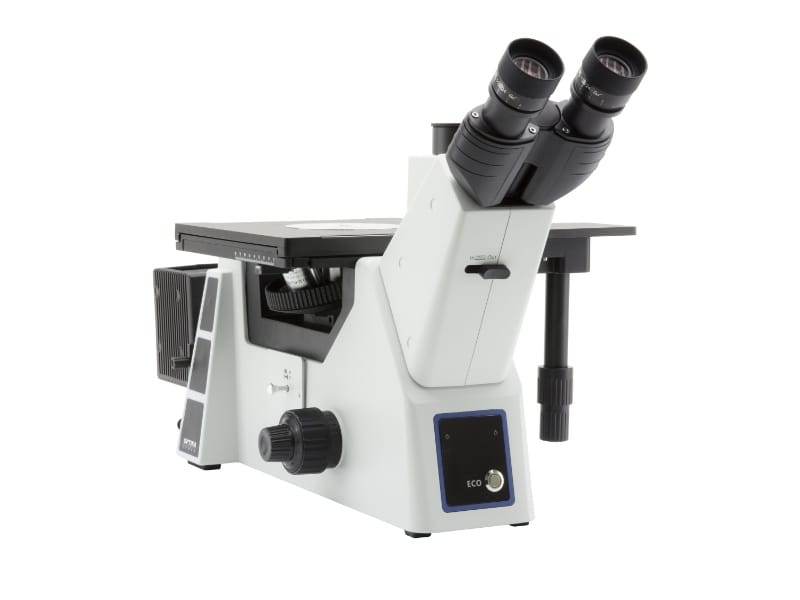
- Type: Inverted metallurgical, trinocular
- Magnification: Up to 1000x
- Optics: IOS LWD, configurable objective platform
- Illumination: Halogen 100W incident
- Head: Trinocular, 45 degree inclined
€7.386,00 excl. VAT
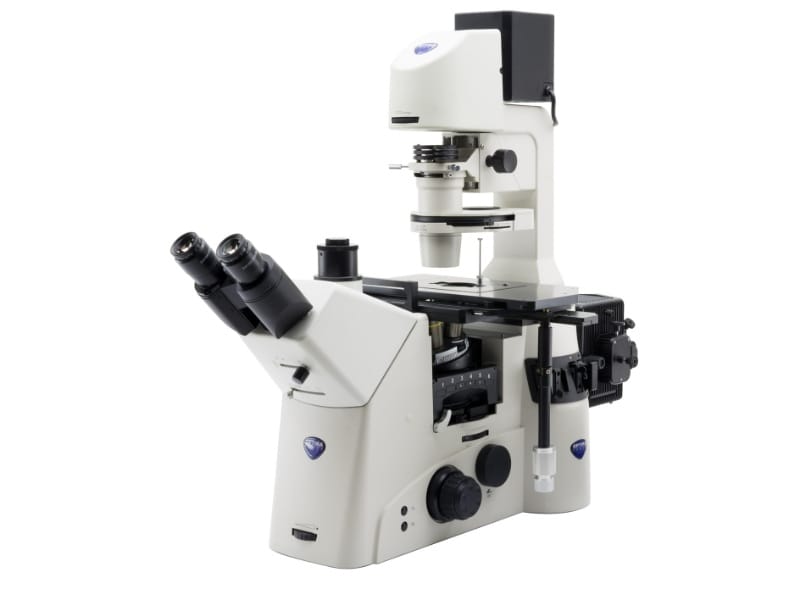
- Type: Inverted research, trinocular
- Magnification: Up to 600x
- Optics: IOS U-PLAN F Semi-Apo, configurable
- Illumination: X-LED10, HBO fluorescence optional
- Head: Trinocular, 45 degree inclined
€16.411,00 excl. VAT
Comparing the IM-300, IM-5, and IM-7 Series
| Series | Positioning | Field number | Illumination | Best suited for |
|---|---|---|---|---|
| IM-300 | Routine, fast setup | 22 mm | X-LED8, 8 W | Everyday brightfield and phase contrast cell culture inspection |
| IM-5 | Research, freely configurable | 24 mm | X-LED8, 8 W | Flexible brightfield, phase contrast, and darkfield work, tall culture vessels |
| IM-7 | Flagship, expandable platform | Configurable by objective | X-LED10, 10 W | Advanced research needing phase contrast, DIC, and future fluorescence expansion |
When to Choose Inverted Over Upright
Choose an inverted microscope whenever your sample lives in a vessel taller than a standard glass slide, most commonly a culture flask, Petri dish, or multi-well plate holding live cells that need to stay hydrated and undisturbed. Because the objective sits beneath the stage, an inverted microscope can view the bottom of a large container directly, without transferring cells to a slide, which would disturb or damage them. If your sample is already mounted on a standard slide, such as a stained tissue section or blood smear, an upright microscope is the more practical and cost-effective choice.
Choosing Between IM-300, IM-5, and IM-7
The IM-300 series is Optika’s routine inverted platform, completely redesigned for exceptional working comfort in everyday use. It combines brightfield and phase contrast for fast, reliable inspections, with best-in-class LED illumination, a pre-centered phase contrast slider for quick setup, and a compact footprint that saves bench space. Digital IM-300D and IM-300LD4D variants add a large 4K touchscreen monitor and a high-sensitivity camera for one-screen documentation.
The IM-5 series moves up to a research-grade platform with the widest field of view available on an inverted microscope in its category, a 24 mm field number. Its Kohler condenser rotates fully out of the optical path, extending the working distance to accommodate tall or voluminous sample vessels, and the objective set is freely configurable across brightfield, phase contrast, and darkfield to match the specific needs of the application. The IM-5FLD variant adds LED fluorescence with blue, green, and UV filter sets included, and IM-5MET adapts the platform for opaque metallographic samples viewed from below with a DIC slot for surface topography work.
The IM-7 series is Optika’s flagship inverted imaging platform, built for research laboratories that need maximum expandability. It ships as a configurable base with a 6-position Kohler condenser covering phase contrast and DIC, a magnification changer (1x, 1.5x), and a built-in Bertrand lens, then scales up through optional packages for HBO fluorescence, DIC, and polarized light as research needs grow.
Why Choose Optika for Inverted Microscopy
Across all three series, Optika builds around the exclusive X-LED illumination system, either X-LED8 (IM-300, IM-5) or the more powerful X-LED10 (IM-7), giving constant 6300K or 6000K color temperature at every intensity level, over 90% lower power consumption than halogen sources, and a lifetime of 50,000 to 65,000 hours without lamp replacement. Every Optika inverted microscope carries a 10-year mechanical and optical warranty plus a lifetime warranty on the X-LED illumination source.
Related Microscope Categories
Inverted microscopes cover four observation techniques, each with its own dedicated category. Go directly to inverted brightfield microscopes for routine live cell observation, inverted phase contrast microscopes for unstained cell structures, inverted fluorescence microscopes for immunofluorescence and live cell fluorescence imaging, or inverted metallurgical microscopes for opaque samples viewed from below.
If your sample sits on a standard glass slide, see our upright microscopes. For low-magnification, three-dimensional viewing of bulk samples, see our stereo microscopes. For the full range overview, see light microscopes.