
Inverted brightfield microscopes
Transmitted brightfield illumination is one of the most commonly used observation methods in optical microscopy, ideal for fixed, stained specimens or samples with high natural light absorption. On an inverted microscope, brightfield is used to check overall culture health, confluency, and morphology at a glance. Every Optika inverted model pairs brightfield with phase contrast on the same condenser and light path, since researchers monitoring live cultures typically need both: brightfield for a quick overview and phase contrast for detailed, unstained internal cell structure, without swapping instruments or reloading the sample.
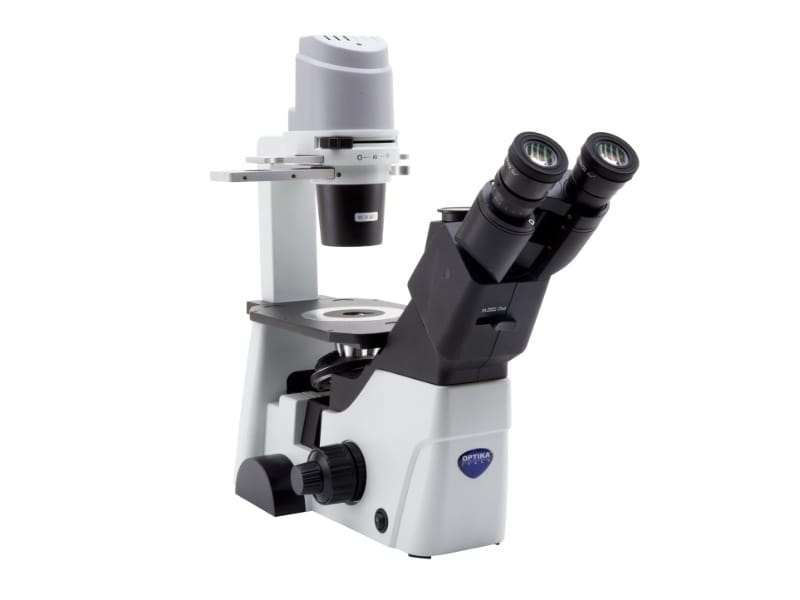
- Type: Inverted brightfield/phase contrast
- Magnification: Up to 400x
- Optics: IOS LWD W-PLAN PH
- Illumination: X-LED8
- Head: Trinocular, 45 degree inclined
€2.754,00 excl. VAT
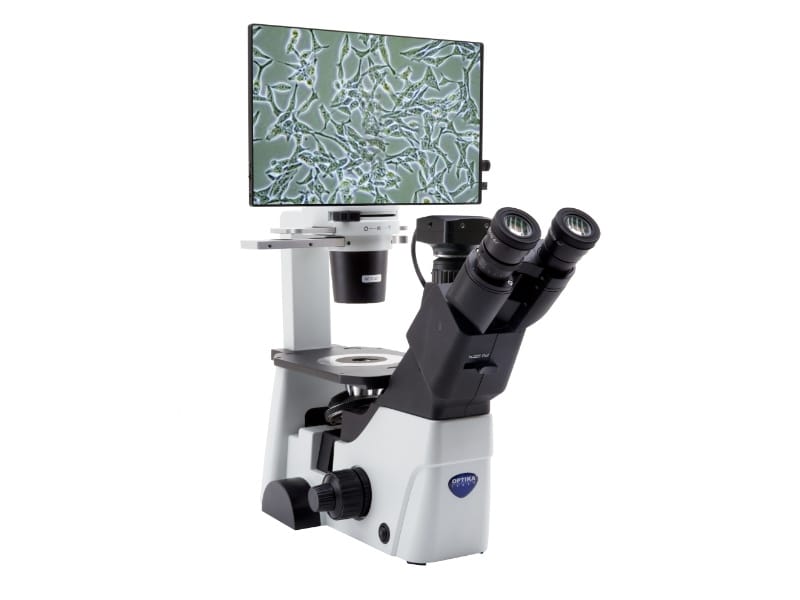
- Type: Inverted brightfield/phase contrast, digital
- Magnification: Up to 400x
- Optics: IOS LWD W-PLAN PH
- Illumination: X-LED8
- Head: Trinocular with 6.3 MP camera
€5.086,00 excl. VAT
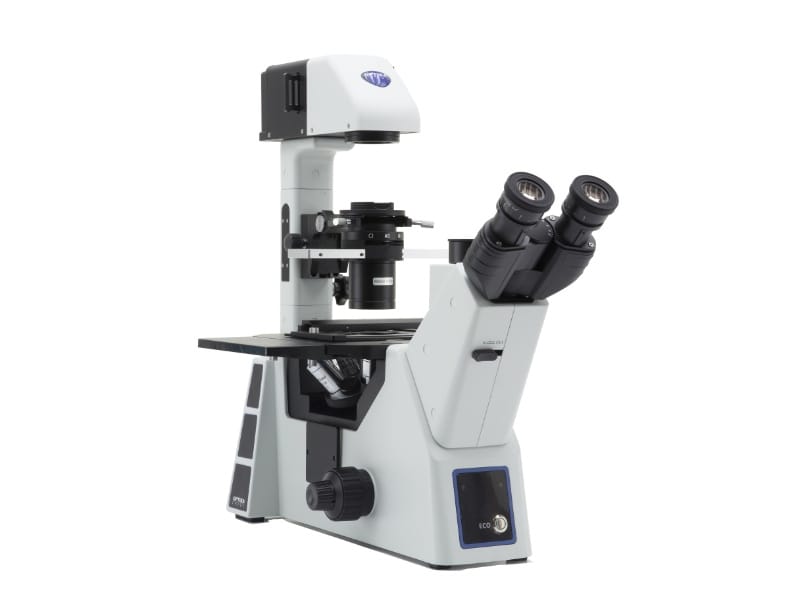
- Type: Inverted brightfield/phase contrast, trinocular
- Magnification: Up to 600x
- Optics: IOS LWD, configurable objective platform
- Illumination: X-LED8 transmitted
- Head: Trinocular, 45 degree inclined
€4.218,00 excl. VAT
Comparing Optika Inverted Brightfield Models
| Model | Techniques | Objectives | Notable feature |
|---|---|---|---|
| IM-300 | Brightfield, phase contrast | 3 IOS LWD W-PLAN PH objectives included (10x, 20x, 40x) | Accessible, ready-to-use routine setup |
| IM-300D | Brightfield, phase contrast | Same as IM-300 | Built-in PC, 15.6 inch 4K touchscreen, 6 MP camera |
| IM-5 | Brightfield, phase contrast, darkfield | Freely configurable, sold separately | 24 mm field number, condenser extends for tall vessels |
| IM-7 | Brightfield, phase contrast (DIC, fluorescence, polarized light optional) | Configurable, sold separately | Flagship, fully expandable research platform |
Why Brightfield and Phase Contrast Come Together on Inverted Microscopes
Live cell cultures are usually transparent and give little contrast under plain brightfield illumination, so laboratories that need brightfield on an inverted stand almost always need phase contrast as well, to see the internal detail of unstained cells without switching microscopes. Optika builds this pairing into every inverted model, sharing the same condenser and light source across both techniques.
Choosing the Right Model
The IM-300 is Optika’s routine inverted microscope, built for first-class optical quality and mechanical versatility at an accessible entry point. It ships with a set of 3 IOS LWD W-PLAN PH objectives (10x, 20x, 40x) included as standard, and the high-efficiency X-LED8 illumination makes it reliable for all transmitted light work. It suits laboratories that want a dependable, ready-to-use brightfield and phase contrast setup, with the option to extend later through accessories such as additional objectives, a mechanical stage, side extensions, holders, and stage inserts.
The IM-300D is the digital version of the same platform, adding a built-in Intel micro PC, a 15.6 inch 4K touchscreen, a 6 MP high-sensitivity color camera, Optika ProView image analysis software, and a wireless mouse and keyboard, so documentation and image capture happen on one screen without a separate computer.
The IM-5 moves to a research-grade platform, adding darkfield to brightfield and phase contrast on the same stand. Its objectives are freely configurable to match your preferences rather than fixed, with a 24 mm field number, infinity-corrected optics, a coaxial focusing mechanism, a mechanical stage, an Abbe condenser, and the same powerful 8 W X-LED8 illumination. It particularly suits cell culture laboratories that want to choose their own objective combination and need the sturdiness for daily, intensive use.
The IM-7 is Optika’s flagship, fully expandable inverted platform. Like the other models, it carries a high-efficiency LED brightfield illuminator for the best results with fixed, stained specimens or other samples with high natural light absorption, but its real strength is expandability: it is built to scale up with optional DIC, fluorescence, and polarized light packages as a research group’s needs grow, making it the choice for advanced life science research programs that expect to add techniques over time.
Related Microscope Categories
If your sample needs more than brightfield and phase contrast, see inverted fluorescence microscopes for immunofluorescence and live cell fluorescence imaging, or inverted metallurgical microscopes for opaque samples viewed from below.
If your sample is already mounted on a standard glass slide, see our compound brightfield microscopes. For the full inverted range overview, see inverted microscopes.