
Stereo microscopes
A stereo microscope, also known as a dissecting microscope, gives a true three-dimensional view of a specimen by using two separate optical paths, one for each eye, rather than the single path of a compound microscope. This lets you see depth and surface detail on solid, opaque objects you could pick up and hold, at a lower magnification than a compound microscope but with far better working distance and spatial awareness. Because stereo microscopes work with reflected light and need no slide preparation, they are used across biology, geology, electronics, and industrial inspection wherever a sample needs to be examined, manipulated, or worked on in real time.
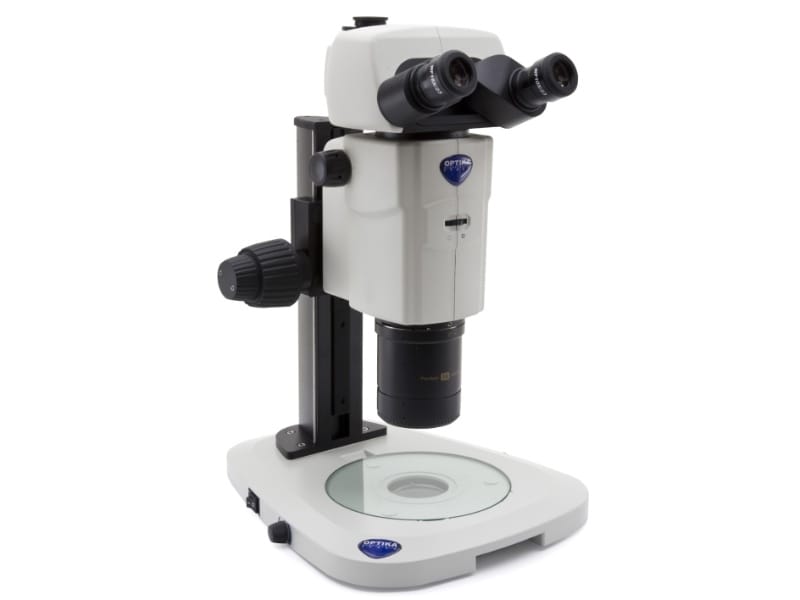
- Type: Stereomicroscope, trinocular
- Magnification: 7.5x to 135x
- Optics: PLAN Apochromatic, CMO zoom
- Illumination: LED with OIC oblique lever
- Head: Trinocular, 20 degree inclined
€9.594,00 excl. VAT
Stereo Microscopes vs. Compound Microscopes
| Aspect | Stereo microscope | Compound microscope (upright/inverted) |
|---|---|---|
| Image type | True three-dimensional, via two separate optical paths | Two-dimensional, single optical path |
| Typical magnification | 7.5x-135x | 40x-1000x and higher |
| Sample preparation | None required, view as-is | Usually requires mounting, staining, or sectioning |
| Illumination | Mainly reflected (incident), sometimes transmitted | Mainly transmitted (or reflected for metallurgical) |
| Typical use | Dissection, inspection, handling solid or bulk samples | Detailed observation of thin, mounted, or cultured samples |
How Stereo Microscopy Works
A stereo microscope uses two separate objective and eyepiece paths angled slightly apart, so each eye receives a slightly different view of the specimen, exactly how natural binocular vision perceives depth. This is fundamentally different from a compound microscope, which forms a single image path split only at the eyepieces. Stereo microscopes typically illuminate the specimen with reflected (incident) light from above, though many models also offer transmitted light from below for translucent samples, and they require no staining, sectioning, or mounting, so a specimen can be examined, manipulated, and even worked on directly under the microscope.
Common Applications
In biology and life sciences, stereo microscopes are the standard tool for dissection of plant and animal specimens and for observing model organisms such as fruit flies, worms, and zebrafish, where their depth perception and generous working distance make handling easy. Entomologists use them to study insects without dissection, botanists to examine flowers and plant structures, and paleontologists and geologists to clean and analyze fossils, rocks, and minerals. In electronics and precision manufacturing, stereo microscopes are essential for soldering, circuit board inspection, and quality control, where fine detail and depth perception guide manual work. They are also widely used for coin and gemstone examination, watchmaking, engraving, and general industrial inspection across many other sectors.
Why Choose Optika for Stereo Microscopy
Optika builds its stereo microscopes around the same commitment to quality optics and reliable illumination found across its upright and inverted ranges, backed by a 10-year mechanical and optical warranty plus a lifetime warranty on the X-LED illumination source. Our current stereo range starts with a research-grade CMO zoom model built for life science and quality control applications that need a wide zoom range and flexible illumination technique, with additional models planned to cover a wider range of budgets and applications.
Related Microscope Categories
If you need to examine a sample mounted on a standard glass slide, see our upright microscopes. If you need to observe live cell cultures in their flask or dish from below, see our inverted microscopes. For the full range overview, see light microscopes.