
Phase contrast microscopes
Phase contrast microscopy makes transparent, unstained specimens visible without dyes or fixation. Invented by Frits Zernike in 1934 (earning him the 1953 Nobel Prize in Physics), the technique converts the tiny phase shifts that light undergoes when passing through structures of different refractive index into visible differences in brightness, so living cells and microorganisms appear with clear internal detail exactly as they are. Optika’s phase contrast range spans the mid-range B-380 series, with Automatic Light Control on select models, and the advanced B-510 series, including a dedicated model built for regulated asbestos fiber counting.
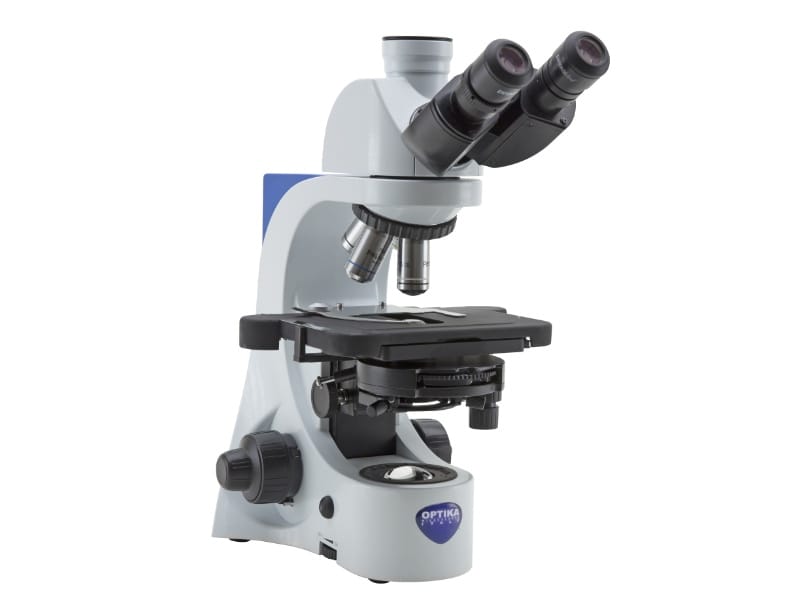
- Type: Phase contrast microscope
- Magnification: 40x – 1000x
- Optics: N-PLAN / W-PLAN
- Illumination: 3.6 W X-LED3 (ALC)
- Head: Binocular, 30 degrees inclined, 360 degrees rotating
€1.778,00 excl. VAT
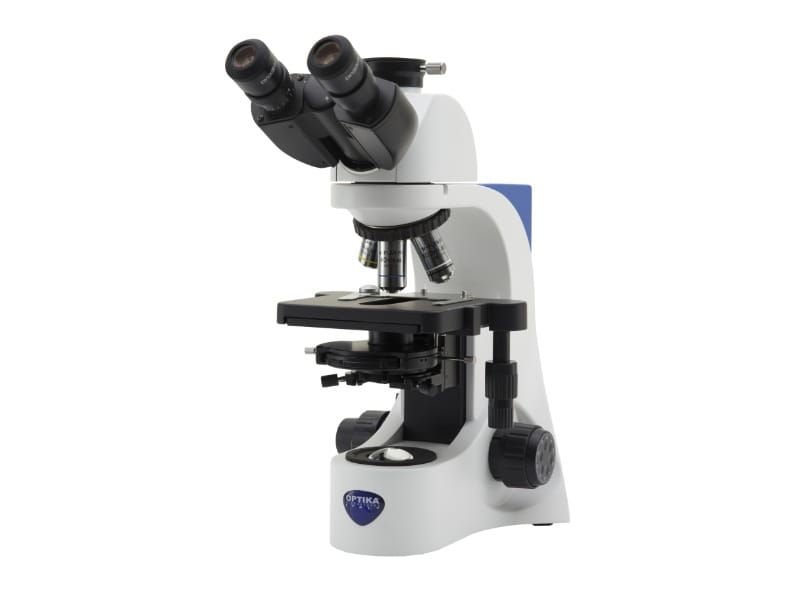
- Type: Phase contrast, trinocular
- Magnification: Up to 1000x
- Optics: N-PLAN / W-PLAN PH objectives
- Illumination: X-LED3
- Head: Trinocular, 30 degree inclined
€1.694,00 excl. VAT
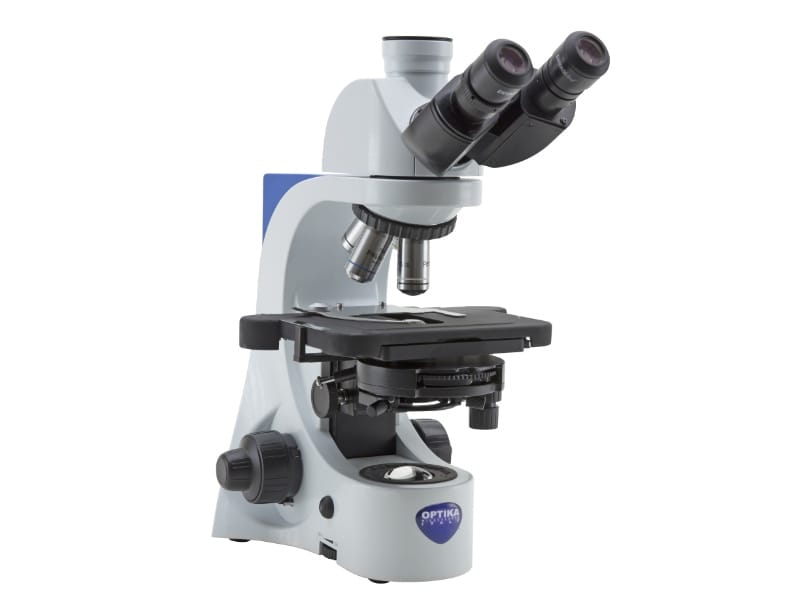
- Type: Phase contrast, binocular
- Magnification: Up to 1000x
- Optics: IOS W-PLAN PH, infinity corrected
- Illumination: X-LED3 with ALC
- Head: Binocular, 30 degree inclined
€2.138,00 excl. VAT
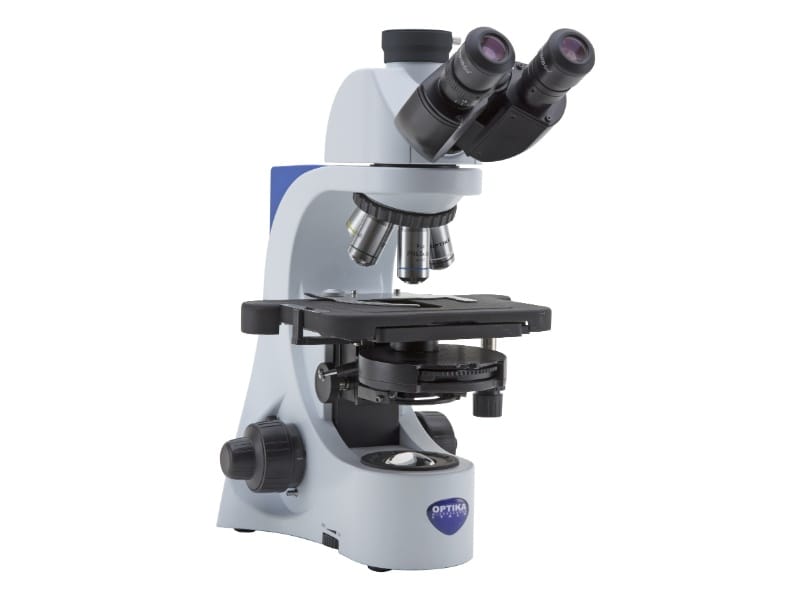
- Type: Phase contrast, trinocular
- Magnification: Up to 1000x
- Optics: IOS W-PLAN PH, infinity corrected
- Illumination: X-LED3
- Head: Trinocular, 30 degree inclined
€2.050,00 excl. VAT
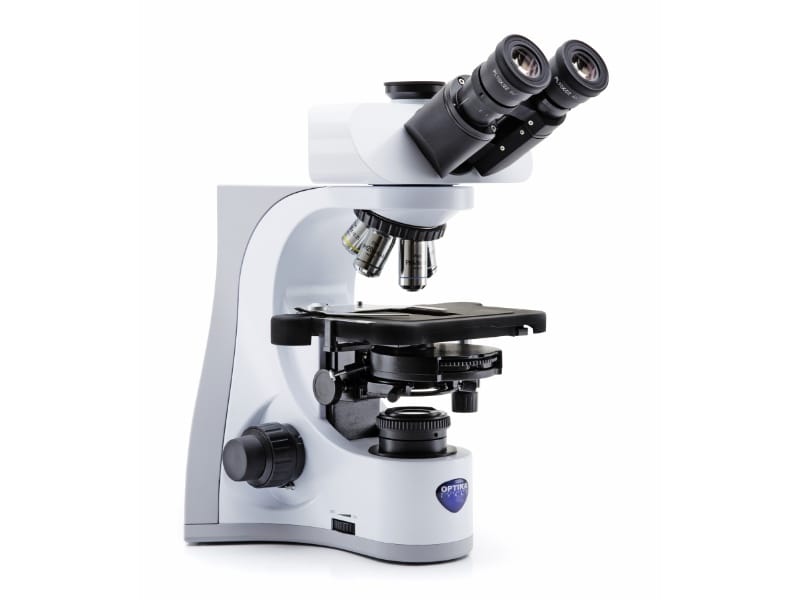
- Type: Phase contrast, trinocular
- Magnification: Up to 1000x
- Optics: IOS W-PLAN PH, infinity corrected
- Illumination: X-LED3, full Kohler
- Head: Trinocular, 30 degree inclined
€2.203,00 excl. VAT
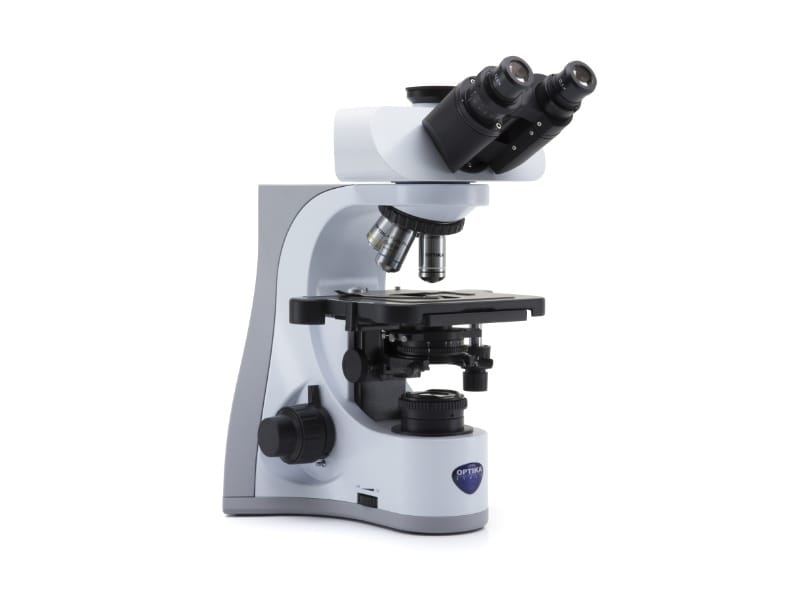
Optika B-510ASB Trinocular phase contrast microscope, 1000x, IOS W-PLAN, Walton and Beckett eyepiece
- Type: Phase contrast, trinocular
- Magnification: Up to 1000x
- Optics: IOS W-PLAN, infinity corrected
- Illumination: X-LED3, full Kohler
- Head: Trinocular, 30 degree inclined
€2.258,00 excl. VAT
Comparing Optika Phase Contrast Models
| Model | Series | Head | Optics | Notable feature |
|---|---|---|---|---|
| B-382PH-ALC | B-380 | Binocular | W-PLAN PH, finite | Automatic Light Control |
| B-382PHi-ALC | B-380 | Binocular | IOS W-PLAN PH, infinity | Automatic Light Control, infinity optics |
| B-383PH | B-380 | Trinocular | W-PLAN PH, finite | Camera port for documentation |
| B-383PHi | B-380 | Trinocular | IOS W-PLAN PH, infinity | Infinity optics with camera port |
| B-510PH | B-510 | Trinocular | IOS W-PLAN PH, infinity | 22 mm field number, full Kohler illumination |
| B-510ASB | B-510 | Trinocular | IOS W-PLAN PH, infinity | Walton and Beckett graticule for regulated fiber counting |
How Phase Contrast Microscopy Works
Living cells and other transparent specimens barely absorb light, so they show almost no contrast under standard brightfield illumination. As light passes through regions of different thickness and refractive index, it shifts slightly out of phase, information the human eye cannot detect directly. A phase contrast microscope uses a condenser annulus and a matching phase plate in the objective to convert that phase shift into a visible difference in brightness, typically showing thicker structures such as the nucleus and mitochondria as dark detail against a lighter background, without any staining or sample preparation.
Common Applications
The most common use of phase contrast is observing living cells in culture to study shape, growth, movement, and division in real time, which makes it standard in cancer research, stem cell studies, and general cell biology. It is also widely used in microbiology to visualize the structure and motility of bacteria and protozoa, in hematology to examine blood cells without staining, and in histology and cytology for cell and tissue features such as nuclei, mitotic spindles, and cytoplasmic granules. A specialized application is phase contrast microscopy (PCM) fiber counting for occupational asbestos exposure testing, which follows international regulations and requires a calibrated Walton and Beckett graticule eyepiece.
Choosing Between the Series
The B-380 series brings phase contrast to a mid-range platform with N-PLAN or IOS N-PLAN infinity optics, a multi-position condenser covering brightfield, phase contrast, and darkfield on dry objectives, and Automatic Light Control on the B-382PH-ALC and B-382PHi-ALC models. The B-510 series moves to a 22 mm field of view with IOS W-PLAN PH objectives and full Kohler illumination for research-grade contrast and resolution. Within the B-510 range, B-510ASB is purpose-built for phase contrast microscopy fiber counting, with a Walton and Beckett graticule eyepiece for calibrated asbestos fiber counting fields, while B-510PH is the general-purpose research phase contrast model.
Differences Within Each Series
B-382PH-ALC is a binocular model with finite W-PLAN PH optics and Automatic Light Control; B-382PHi-ALC adds infinity-corrected IOS optics to the same ALC binocular configuration. B-383PH and B-383PHi are the trinocular B-380 counterparts, with B-383PHi again offering IOS infinity optics for compatibility with future accessories. In the B-510 series, B-510PH is the standard trinocular phase contrast configuration for routine and research work, while B-510ASB replaces the standard eyepiece pairing with a 12.5x Walton and Beckett graticule eyepiece specifically for regulated fiber counting.
Related Microscope Categories
If phase contrast is not the right technique for your sample, see compound brightfield microscopes for stained routine samples, darkfield microscopes for live blood analysis, polarized light microscopes for birefringent minerals and crystals, upright fluorescence microscopes for immunofluorescence work, or upright metallurgical microscopes for opaque metal and ceramic samples.
If you need to observe live cell cultures in their flask or dish, see our inverted microscopes. For the full upright range overview, see upright microscopes.