
Polarized light microscopes
Polarized light microscopy is perhaps best known for its geological applications, particularly the study of minerals in rock thin sections, though the technique extends to a wide range of other birefringent materials. It reveals a specimen’s optical anisotropy, information invisible under ordinary illumination, by passing plane-polarized light through the sample and analyzing the resulting interference patterns. A dedicated polarizing microscope needs polarizer and analyzer filters, a Bertrand lens for conoscopic observation, compensator or tint plates, and a high-precision rotatable stage, all of which Optika builds into its B-380 and B-510 series polarizing models.
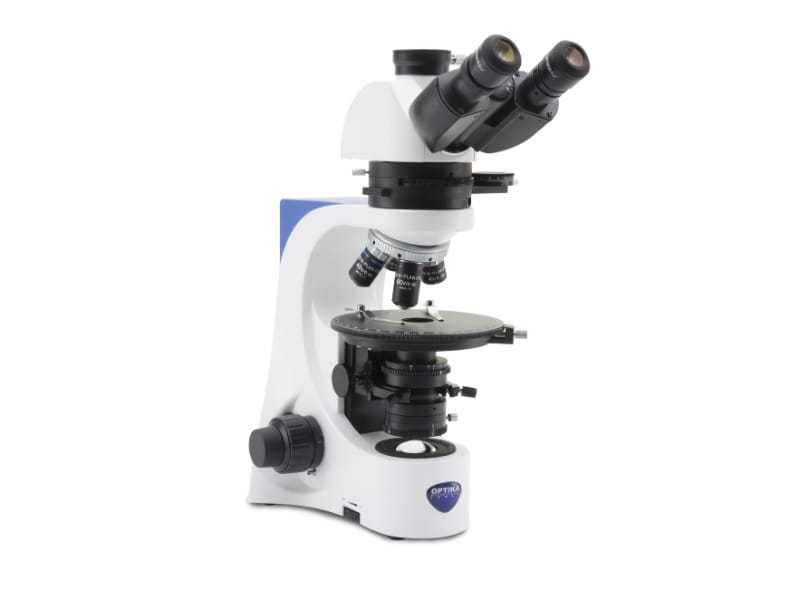
- Type: Polarizing, trinocular
- Magnification: Up to 600x
- Optics: IOS N-PLAN POL, infinity corrected
- Illumination: X-LED3
- Head: Trinocular, 30 degree inclined
€2.436,00 excl. VAT
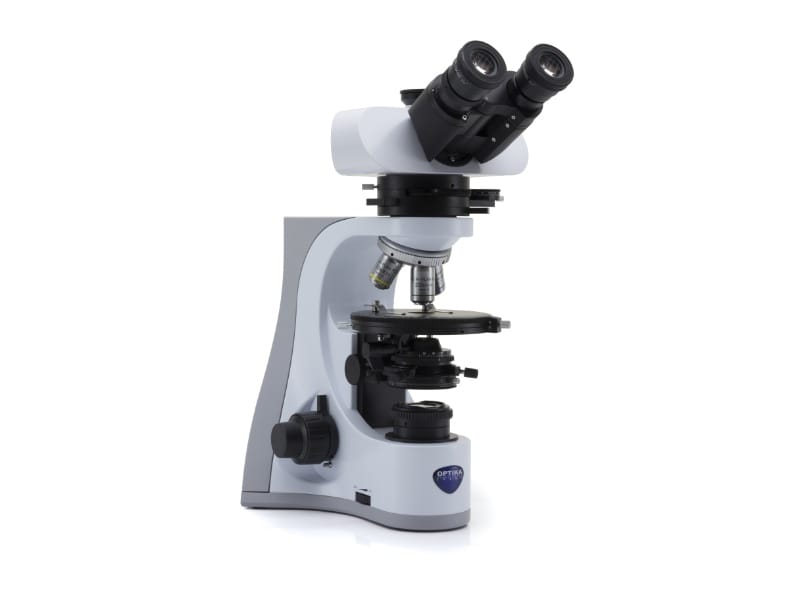
- Type: Polarizing, trinocular
- Magnification: Up to 400x
- Optics: IOS W-PLAN POL, infinity corrected
- Illumination: X-LED3, full Kohler
- Head: Trinocular, 30 degree inclined
€2.611,00 excl. VAT
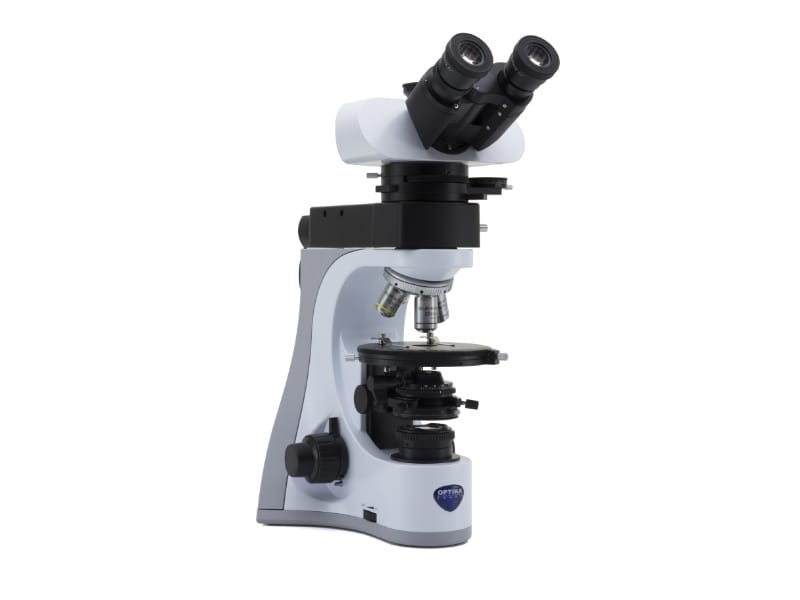
- Type: Polarizing, trinocular
- Magnification: Up to 500x
- Optics: IOS LWD W-PLAN POL, infinity corrected
- Illumination: X-LED8 incident, X-LED3 transmitted
- Head: Trinocular, 30 degree inclined
€5.033,00 excl. VAT
Comparing Optika Polarized Light Models
| Model | Series | Light path | Optics | Notable feature |
|---|---|---|---|---|
| B-383POL | B-380 | Transmitted only | IOS N-PLAN POL, up to 60x | Bertrand lens, rotating stage, tint plates included |
| B-510POL | B-510 | Transmitted only | IOS W-PLAN POL, up to 40x | Wider field of view, full Kohler illumination |
| B-510POL-I | B-510 | Incident and transmitted | IOS LWD W-PLAN POL, up to 50x | Combines petrographic and ore microscopy in one instrument |
How Polarized Light Microscopy Works
A polarizer beneath the condenser converts ordinary light into plane-polarized light before it reaches the specimen. Birefringent (anisotropic) materials split this light into two rays traveling at different speeds, which recombine at the analyzer above the specimen to produce interference colors and extinction patterns that reveal crystal structure, orientation, and composition. Isotropic materials, which do not split the light, appear dark under crossed polarizers. A Bertrand lens allows conoscopic observation of interference figures for detailed optical axis analysis, while compensator or tint plates help determine the sign and magnitude of birefringence.
Common Applications
Geology and petrography remain the classic application, identifying minerals and studying rock texture in thin sections using extinction behavior and interference colors. Beyond geology, polarized light microscopy is used in materials science for ceramics, composites, glass, and polymer failure analysis, where mechanical stress induces visible birefringence; in medicine for diagnosing gout by identifying monosodium urate crystals in synovial fluid with a first-order retardation plate; and in forensics, textiles, and pharmaceutical research for identifying fibers, starches, and crystalline compounds. Reflected-light (incident) polarization is used for opaque or highly scattering materials such as ores and polished metal surfaces, where the contrast mechanism works through reflection rather than transmission.
Choosing Between the Series
The B-380 series polarizing model works in transmitted light only, with IOS N-PLAN POL objectives up to 60x, suited to standard thin section and crystal work. The B-510 series offers two configurations: B-510POL, also transmitted light only but with a wider magnification range and IOS W-PLAN POL optics, and B-510POL-I, which adds a full incident (reflected) light polarizing path alongside transmitted light, letting the same microscope examine both transparent thin sections and opaque ore or metal samples.
Differences Within Each Series
All three models include the essentials for serious polarized light work: a centerable and focusable Bertrand lens, a 360 degree rotatable analyzer, and lambda, lambda/4, and quartz wedge tint plates for compensation techniques. B-510POL-I additionally uses IOS LWD (long working distance) objectives and a dedicated X-LED8 incident light source, making it the choice for laboratories that regularly move between transmitted petrographic work and reflected-light ore microscopy on the same instrument.
Related Microscope Categories
If polarized light is not the right technique for your sample, see compound brightfield microscopes for stained routine samples, darkfield microscopes for live blood analysis, phase contrast microscopes for unstained cell structures, upright fluorescence microscopes for immunofluorescence work, or upright metallurgical microscopes for opaque metal and ceramic samples viewed in reflected light only.
For the full upright range overview, see upright microscopes.