
Upright metallurgical microscopes
Metallurgical (metallographic) microscopy is reflected light microscopy, used for imaging specimens that remain opaque even when ground down to a thickness of a few microns. This covers most metals, ores, ceramics, many polymers, semiconductors (unprocessed silicon, wafers, and integrated circuits), coal, plastics, paint, paper, wood, leather, glass inclusions, and a wide variety of other specialized materials. Optika’s metallurgical range spans the B-380 series, which combines incident and transmitted light on one condenser, and the B-510 series, offered in an incident-only version and a version that adds a separate transmitted light path.
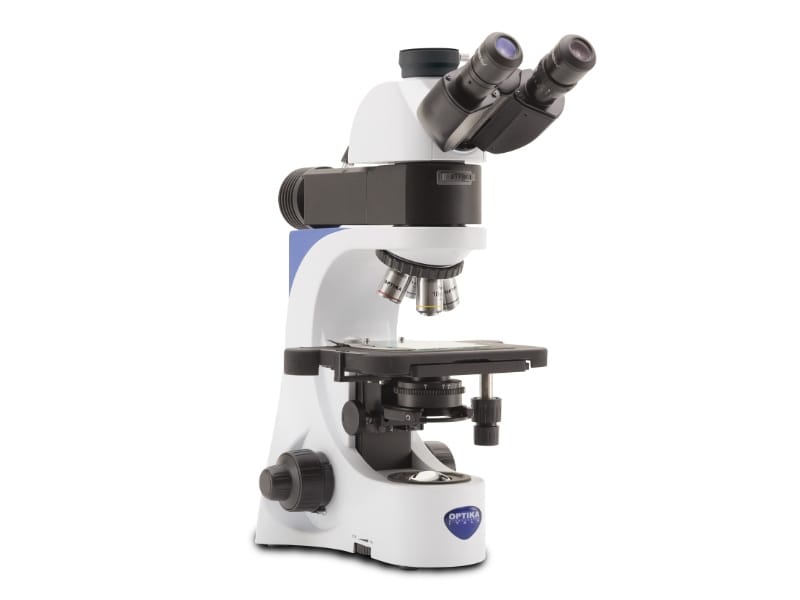
- Type: Metallurgical, trinocular
- Magnification: Up to 500x
- Optics: IOS W-PLAN MET, no cover glass
- Illumination: X-LED3, transmitted and incident
- Head: Trinocular, 30 degree inclined
€2.249,00 excl. VAT
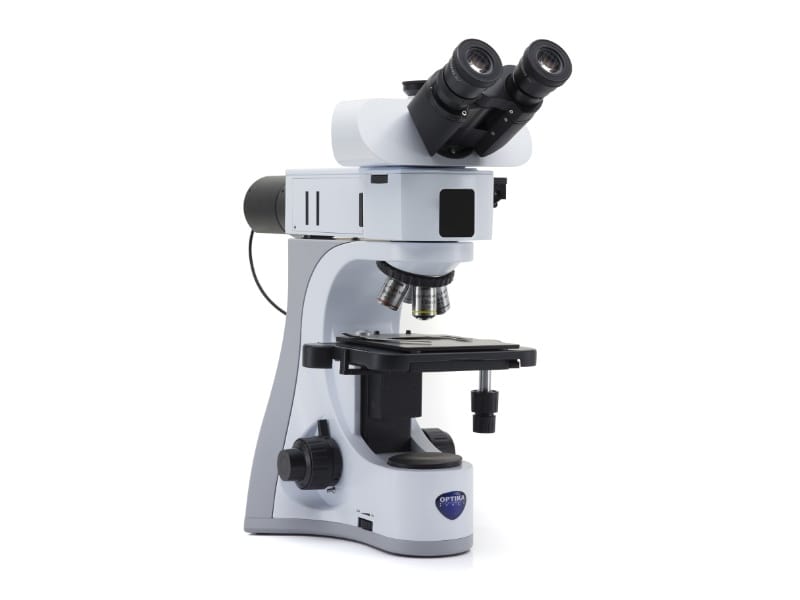
- Type: Metallurgical, trinocular
- Magnification: Up to 500x
- Optics: IOS W-PLAN MET, infinity corrected
- Illumination: X-LED8, incident light
- Head: Trinocular, 30 degree inclined
€4.389,00 excl. VAT
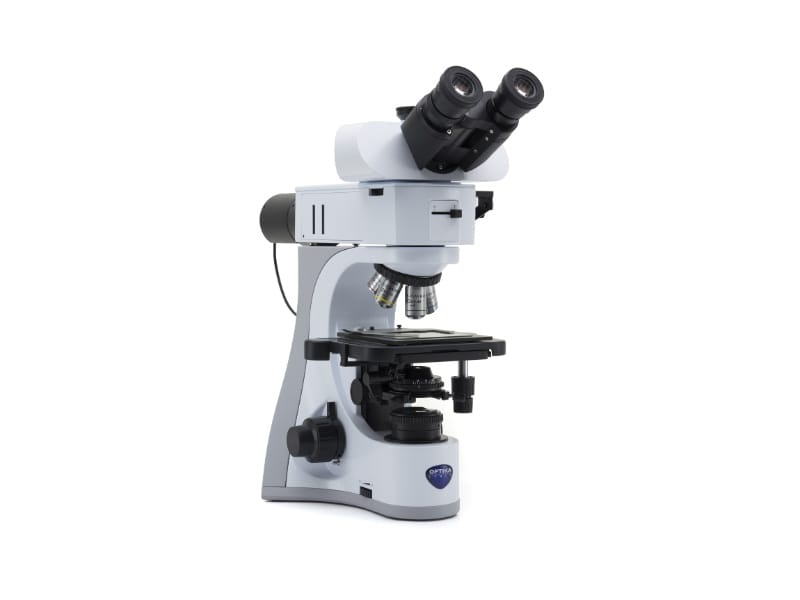
- Type: Metallurgical, trinocular
- Magnification: Up to 500x
- Optics: IOS W-PLAN MET, infinity corrected
- Illumination: X-LED8 incident, X-LED3 transmitted
- Head: Trinocular, 30 degree inclined
€4.558,00 excl. VAT
Comparing Optika Upright Metallurgical Models
| Model | Series | Light path | Illumination | Max sample height |
|---|---|---|---|---|
| B-383MET | B-380 | Incident and transmitted, combined | X-LED3, 3.6 W | 15 mm |
| B-510MET | B-510 | Incident only | X-LED8, 8 W | 33 mm |
| B-510METR | B-510 | Incident and transmitted, separate paths | X-LED8 incident, X-LED3 transmitted | 31 mm |
How Metallurgical Microscopy Works
Because opaque samples do not transmit light, a metallurgical microscope illuminates the specimen from above through the objective itself, and forms an image from the light reflected back off the polished surface. Surface features such as grain boundaries, inclusions, porosity, and coating layers create contrast through differences in reflectivity, so sample preparation typically involves cutting, mounting, grinding, and polishing to a flat, reflective surface, often followed by etching to reveal microstructure.
Common Applications
Metallurgical microscopy is the standard tool for examining metal and alloy microstructure in quality control and failure analysis, mineral and ore examination in mining and geology, and semiconductor inspection of unprocessed silicon, wafers, and integrated circuits. It is also used for ceramics, ceramics composites, polymers, coal, and a wide range of other opaque materials including paint, paper, wood, leather, and glass inclusions, wherever a surface needs to be characterized in reflected light rather than transmitted light.
Choosing Between the Series
The B-380 series metallurgical model combines transmitted and incident X-LED3 illumination through the same condenser, giving brightfield, oblique, and simple polarized light on opaque samples in a single, compact configuration. The B-510 series separates the two light paths for more capability: B-510MET is an incident-only model built around the more powerful X-LED8 source, suited to laboratories that work exclusively with opaque samples, while B-510METR adds a full transmitted light path with its own swing-out condenser, letting the same stand examine opaque metallographic samples and transparent thin sections without switching instruments.
Differences Within Each Series
All three models use IOS W-PLAN MET no-cover-glass objectives, designed specifically for direct observation of polished metallographic samples without a cover slip. B-383MET reaches 500x with a maximum sample height of 15 mm. B-510MET and B-510METR both include a polarizer with a 360 degree rotatable analyzer for oblique and simple polarized light on opaque samples; B-510METR’s added transmitted light path also supports brightfield, phase contrast, darkfield, and polarized light on transparent specimens, at the cost of a slightly lower maximum sample height (31 mm versus 33 mm on B-510MET) to accommodate the additional condenser.
Related Microscope Categories
If metallurgical is not the right technique for your sample, see compound brightfield microscopes for transparent stained samples, darkfield microscopes for live blood analysis, phase contrast microscopes for unstained cell structures, polarized light microscopes for transmitted-light birefringent minerals and crystals, or upright fluorescence microscopes for immunofluorescence work.
For materials that benefit from viewing from below, see our inverted metallurgical microscopes. For the full upright range overview, see upright microscopes.