
Microplate shakers
Microplate shakers use a short, exact orbital motion built specifically for microplates and deep-well plates, keeping the sample moving evenly without splashing out of the wells even at high speed. Labman stocks models from Edmund Buhler and Ohaus, from a compact entry-level shaker for a handful of plates up to a scalable platform that grows from 8 to 48 plates using optional racks, with both analog trays and programmable touch-screen control available.
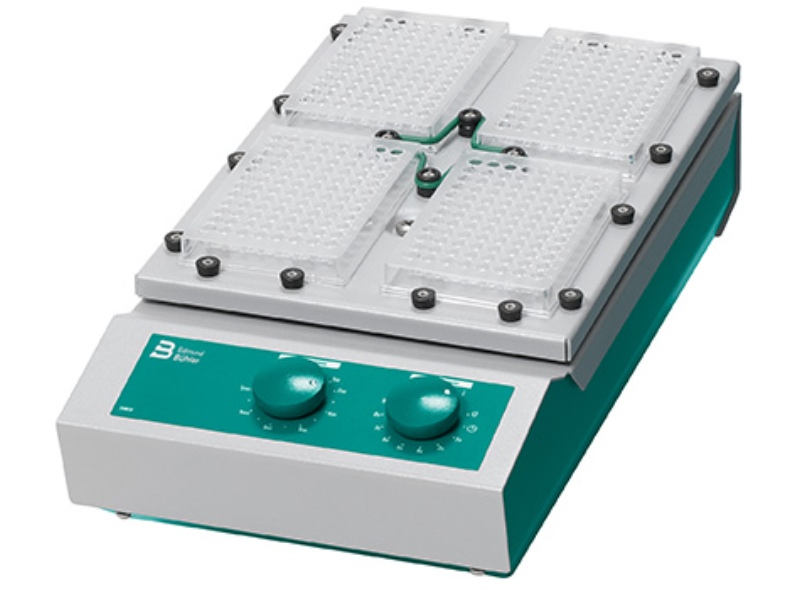
- Motion: exact orbital motion
- Shaking platform: 200 x 295 mm for 4 microplates
- Max. load: 2 kg
- Shaking speed: 100 – 1400 min-1, steplessly adjustable
- Stroke: 3 mm
€1.832,00 excl. VAT
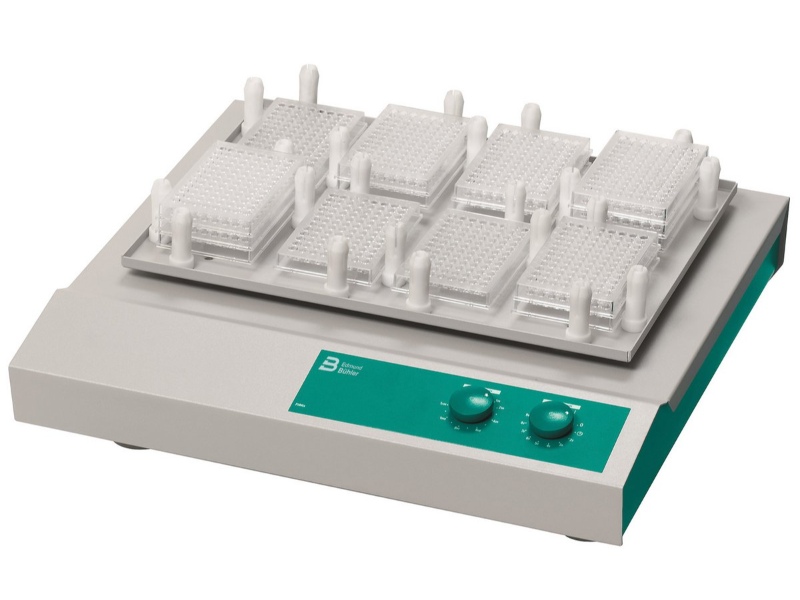
- Motion: exact orbital motion
- Shaking platform: 400 x 300 mm for 8 microplates
- Max. load: 5 kg
- Shaking speed: 100 – 1400 rpm, steplessly adjustable
- Stroke: 3 mm
€2.384,00 excl. VAT
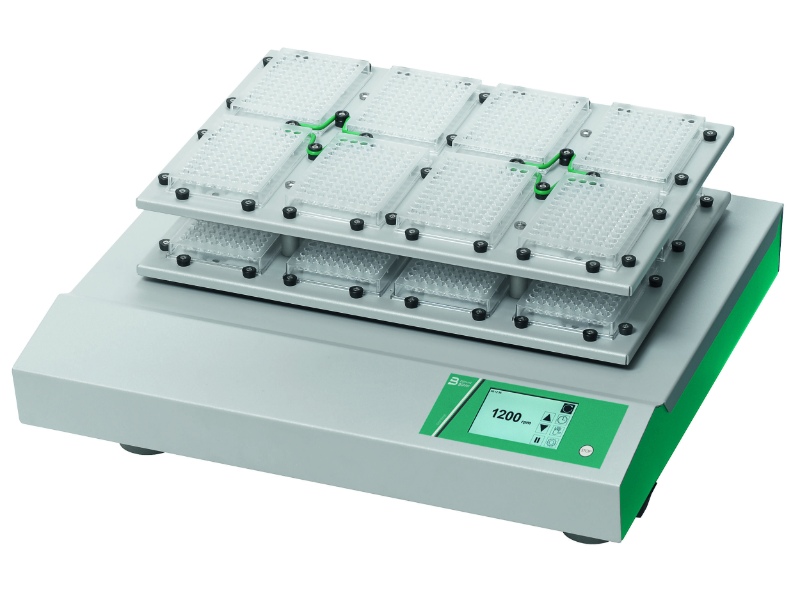
- Motion: exact orbital motion
- Shaking platform: 400 x 300 mm for 8 microplates
- Max. load: 5 kg
- Shaking speed: 100 – 1400 rpm, in steps of 5
- Stroke: 3 mm (Special stroke on request)
€3.540,00 excl. VAT
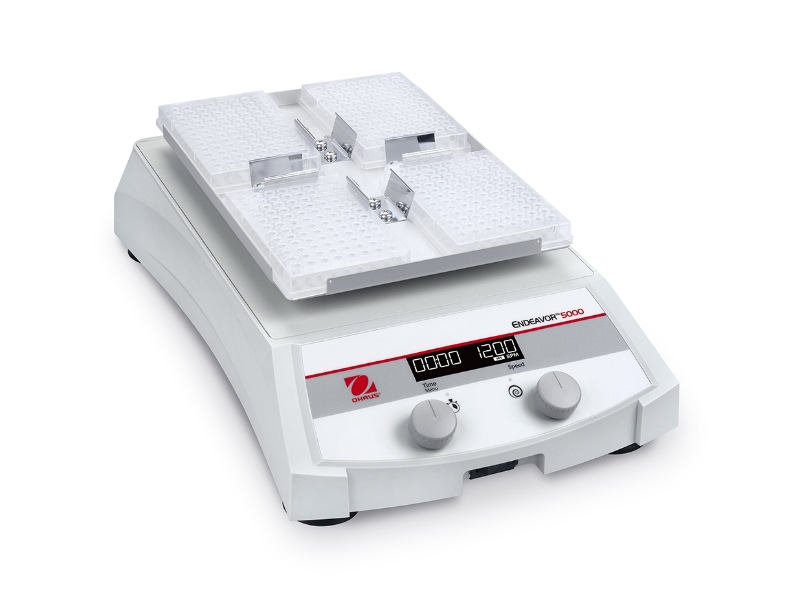
- Motion: orbital
- Shaking platform: 280 x 197 mm
- Max load: 4 Microplates
- Shaking speed: 100 to 1200 rpm
- Stroke: 3 mm
€1.040,00 excl. VAT
| Model | Brand | Speed Range | Plate Capacity | Control | Best For |
|---|---|---|---|---|---|
| e-E51LDMP03 | Ohaus | 100-1200 rpm | 4 plates (V-clip tray) | Digital, programmable | Budget-friendly, small batches |
| TiMix 2 | Buhler | 100-1400 rpm | 4 plates | Analog dial | Compact, entry-level microplate work |
| TiMix 5 | Buhler | 100-1400 rpm | 8-48 plates (rack-dependent) | Analog dial | Scalable throughput |
| TiMix 5 control | Buhler | 100-1400 rpm | 8-48 plates (rack-dependent) | Programmable, touch screen | Large batches, documented protocols |
Why microplate shakers use a different motion
A microplate shaker uses the same orbital principle as a general-purpose shaker, but with a much shorter stroke, typically around 3 mm, and a higher top speed, often over 1000 rpm. This combination keeps the liquid moving evenly inside each well without splashing between wells or out of the plate, which a standard flask shaker’s longer stroke is not built to do. This makes a dedicated microplate shaker the right choice whenever the workload is mostly plates rather than flasks or tubes.
The Buhler TiMix range: from compact to scalable
The Buhler TiMix 2 is a compact shaker built for 4 microplates, with speed up to 1400 rpm. The TiMix 5 uses the same speed range but scales from 8 microplates in its base configuration up to 48 stacked microplates with optional racks, letting a lab grow its throughput without changing instrument. The TiMix 5 control adds a programmable touch screen, RS232 connectivity, and a special-stroke option, for labs that need to store and repeat protocols across large plate batches.
Ohaus Endeavor 5000: a dedicated budget option
The Ohaus e-E51LDMP03 is the microplate-specific model in the Endeavor 5000 line, with a tray built with V-clips and springs to secure plates directly, holding 4 microplates or 2 micro tube racks per cycle. It is a budget-friendly alternative for labs that do not need TiMix-level scalability.
Who uses a microplate shaker
This category suits molecular biology and diagnostic labs running ELISA, screening, and other plate-based assays, and any lab whose workload is dominated by microplates or deep-well plates rather than flasks. Labs processing a handful of plates per run fit the TiMix 2 or the Ohaus e-E51LDMP03; labs running large batches, or that expect throughput to grow, are better served starting on the scalable TiMix 5 platform.
Related shaker categories
For general flask culture and mixing, see our orbital shakers or reciprocating shakers. If your shaker needs to fit inside an incubator or fridge, see our CO2-incubator and miniature shakers. For samples sensitive to shear or foam, see our rocking, tilting, and 3D shakers or our roller mixers. For the largest sample loads, see our multi-flask and heavy-duty shakers. For an overview of the full range, see our laboratory shakers category. If your workflow also needs quick tube mixing, see our laboratory vortex mixers, or for combined shaking and incubation in one unit, see our shaking incubators.