
Rocking, tilting & 3D shakers
Rocking, tilting, and 3D shakers use a slower, gentler motion than an orbital or reciprocating shaker, built for samples that foam or shear too easily under faster agitation. Labman’s range comes from Edmund Buhler, with a three-dimensional wobbling model for an adjustable tilt angle and a linear tilting model for a fixed rocking angle, both sharing the same expandable multi-tier rack system. Capacity runs up to 10 kg across both models.
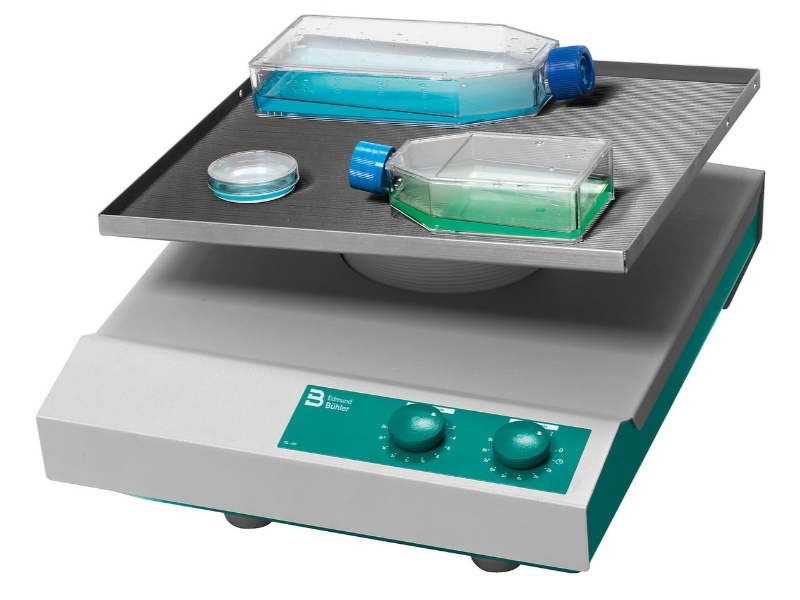
- Motion: three-dimensional orbital motion
- Shaking platform: 340 x 340 mm
- Max. load: 10 kg
- Shaking speed: 1 – 23 rpm, steplessly adjustable
- Angle of tilt: 0° to 9°
€2.512,00 excl. VAT
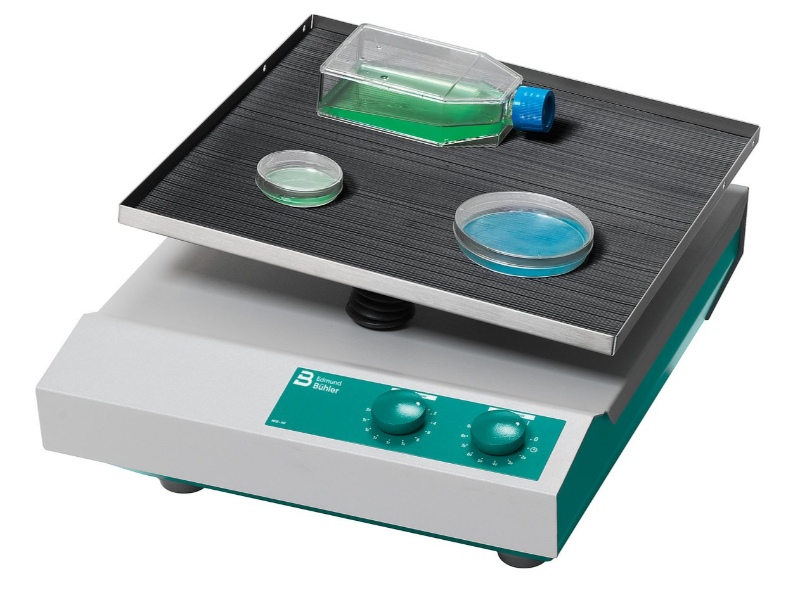
- Motion: linear tilting motion
- Shaking platform: 340 x 340 mm
- Max. load: 10 kg
- Shaking speed: 1 – 23 rpm, steplessly adjustable
- Angle of tilt: 5° fixed
€2.255,00 excl. VAT
| Model | Motion | Tilt Angle | Speed Range | Max Load | Best For |
|---|---|---|---|---|---|
| TL 10 | Three-dimensional wobbling | 0-9 degrees, adjustable | 1-23 rpm | 10 kg | Protocols needing a variable tilt angle |
| WS 10 | Linear tilting (rocking) | 5 degrees, fixed | 1-23 rpm | 10 kg | Standard washing and rocking protocols |
A gentler motion for sensitive samples
Where an orbital or reciprocating shaker moves a sample continuously and relatively energetically, a rocking, tilting, or 3D shaker uses a slower, more gradual motion. This suits protocols where faster agitation would generate foam or apply too much shear, and it is the standard choice for cell culture flasks and Western blot membrane washing, among other applications where gentleness matters more than speed.
The Buhler TL 10 and WS 10
The Buhler TL 10 produces a three-dimensional wobbling motion with an adjustable tilt angle from 0 to 9 degrees, letting the operator match the motion amplitude to the vessel and protocol. The WS 10 uses a simpler linear tilting (rocking) motion at a fixed 5-degree angle, the standard angle for classic washing and incubation protocols. Both run at 1 to 23 rpm and hold up to 10 kg, and both use the same multi-tier rack system, so trays can be added as workload grows and the same accessories work across either model.
Who chooses a rocking, tilting, or 3D shaker
This category suits molecular biology and biochemistry labs running Western blot protocols, cell culture in flasks where foam formation is a concern, and any application where a standard orbital motion would agitate the sample too aggressively. Choose the WS 10 for standard rocking protocols at a fixed angle, and the TL 10 where the tilt angle needs to be adjusted between protocols.
Related shaker categories
For general flask culture and mixing, see our orbital shakers or reciprocating shakers. For the gentlest possible tube and bottle mixing, see our roller mixers. If your shaker needs to fit inside an incubator or fridge, see our CO2-incubator and miniature shakers, and for dedicated microplate work, see our microplate shakers. For larger sample loads, see our multi-flask and heavy-duty shakers. For an overview of the full range, see our laboratory shakers category. If your workflow also needs quick tube mixing, see our laboratory vortex mixers, or for combined shaking and incubation in one unit, see our shaking incubators.