
Labsit laboratory chairs
The Bimos Labsit laboratory chairs offer a smart and budget-friendly solution for seated work in laboratory environments. They combine a compact design, intuitive handling and full laboratory suitability in one versatile chair.
The choice between Labsit 2, Labsit 3 and Labsit 4 mainly depends on the height of your laboratory bench or cabinet. As a general rule, the seat height should be approximately 20 to 25 cm lower than the work surface.
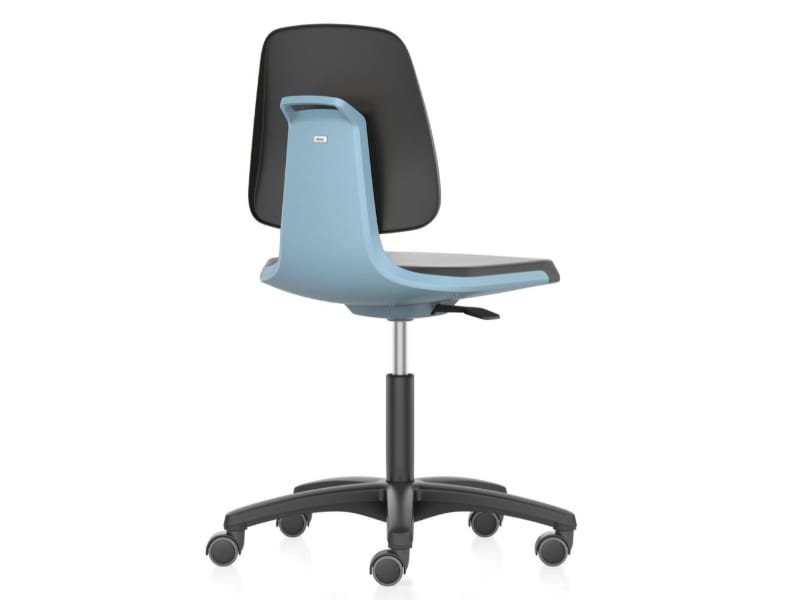
- Seat height range: 450–650 mm
- Recommended working height: 650–850 mm
- Base: Castors (lightweight & mobile)
- Upholstery: Fabric, artificial leather, Skintec or Supertec
- Ergonomics: Flex function with 3D-Flex backrest
€258,00 excl. VAT
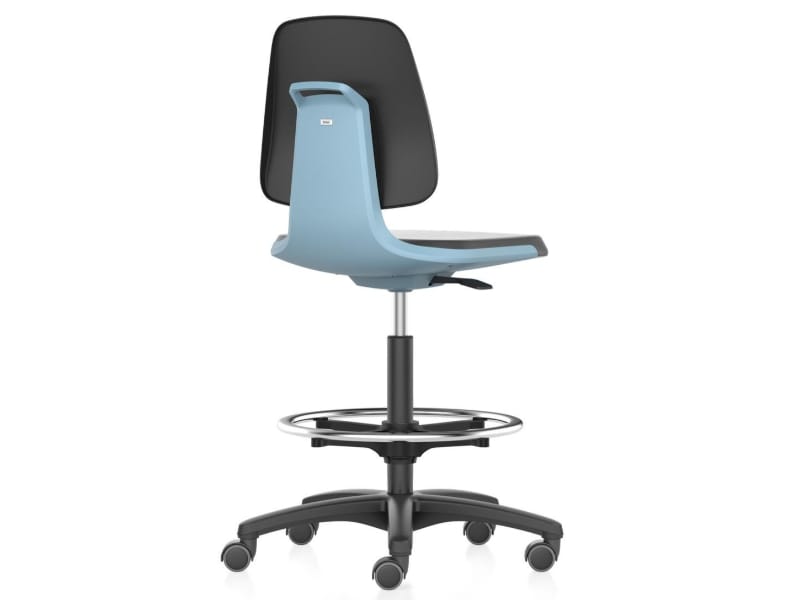
- Seat height range: 560–810 mm
- Recommended working height: 780–1000 mm (ideal for 90 cm benches)
- Base: Castors (BeNeLux preferred configuration)
- Upholstery: Fabric, artificial leather, Skintec or Supertec
- Ergonomics: Flex function + 3D-Flex backrest + foot ring
€330,00 excl. VAT
- Seat height range: 560–810 mm
- Recommended working height: 800–1050 mm (for high benches)
- Base: Brake castors (automatic locking under load)
- Upholstery: Fabric, artificial leather, Skintec or Supertec
- Ergonomics: Flex function + 3D-Flex backrest + foot ring
€335,00 excl. VAT
Which Labsit laboratory chair should you choose?
The main selection criterion is the height of your laboratory bench or workstation. As a guideline, choose a seat height approximately 20 to 25 cm lower than the work surface.
| Feature | Labsit 2 | Labsit 3 | Labsit 4 |
|---|---|---|---|
| Article code | 9123 | 9121 | 9125 |
| Seat height | 450 – 650 mm | 520 – 770 mm | 560 – 810 mm |
| Recommended work height | ± 80 cm | ± 90 cm | > 95 cm |
| Base | Castors | Castors + footring | Safety (braked) castors + footring |
| Mobility | High | High | Controlled |
| Best application | Standard laboratory benches | Raised workstations | High workstations |
| Typical users | Schools, hospitals, general labs | Research, education, raised work areas | Professional labs with higher setups |
Summary: choose Labsit 2 for standard work heights, Labsit 3 for raised workstations and Labsit 4 for higher workstations requiring additional safety.
The smart entry-level laboratory chair
Labsit stands for “simple is clever”: an intelligent combination of simplicity, ergonomics and functionality. The chair provides everything required for laboratory work without complex adjustments or unnecessary features :contentReference[oaicite:0]{index=0}.
With its excellent price-performance ratio, Labsit is the ideal choice for environments where budget plays an important role, such as schools, hospitals, universities and shared laboratory facilities.
Choosing the correct seat height
The most important factor when selecting a laboratory chair is the height of the laboratory bench, worktop or cabinet. A correct seat height ensures a comfortable posture and prevents strain on the shoulders and back.
As a general guideline, the seat height should be approximately 20 to 25 cm lower than the work surface.
- Work height ± 80 cm: Labsit 2 is typically the best solution for standard laboratory benches.
- Work height ± 90 cm: Labsit 3 is the best choice for raised workstations, often configured with castors for Benelux users.
- Work height > 95 cm: Labsit 4 is the preferred solution for high workstations, featuring a footring and safety castors.
Suitable for laboratories, healthcare and education
Labsit chairs are designed for a wide range of applications, including laboratories, hospitals, research institutes and training environments. They offer a reliable and cost-efficient solution for equipping multiple workstations.
This makes Labsit particularly suitable for larger projects where consistent quality, hygiene and budget control are key factors.
Hygienic design and easy maintenance
Hygiene is essential in laboratory environments. Labsit chairs are designed according to Hygienic Design principles, featuring minimal joints and closed surfaces for easy cleaning.
The materials are resistant to disinfectants, chemicals and intensive use, making them suitable for demanding laboratory and healthcare environments :contentReference[oaicite:1]{index=1}.
Intuitive ergonomics with Flex function
Labsit simplifies ergonomics. Instead of complex adjustments, the chair adapts automatically to the user through its innovative Flex function.
The 3D-Flex backrest follows the user’s movements, while the front edge of the seat adapts to forward-leaning working positions typical in laboratory tasks :contentReference[oaicite:2]{index=2}.
- supports the back in different working positions
- reduces pressure on the front of the seat
- promotes dynamic sitting
- ensures intuitive use for multiple users
Compact, lightweight and mobile
Labsit chairs are lightweight and compact, making them easy to move between different workstations. The integrated handle enhances mobility and ease of use.
In the Benelux region, configurations with castors are often preferred, as they support flexible and dynamic working environments.
German design quality
The Labsit range has received the German Design Award, highlighting its combination of functionality, ergonomics and modern design.
Despite its budget-friendly positioning, Labsit remains a true Bimos laboratory chair: robust, hygienic and designed for professional use.
Combine Labsit with other laboratory seating solutions
Labsit laboratory chairs are the ideal entry-level solution for simple applications and budget-driven projects. Depending on your requirements, they can be combined with or upgraded to more advanced seating solutions within the Bimos range.
- Nexxit laboratory chairs for enhanced ergonomics and shared workstations
- Neon laboratory chairs for maximum individual adjustability
- Texon laboratory chairs for premium multi-user environments
- Laboratory stools for short and mobile tasks
- Standing aids for sit-stand flexibility
- Footrests for ergonomic support at elevated workstations
Combining Labsit with other solutions helps you build an ergonomic laboratory setup tailored to both budget and usage intensity.