
Lab Pure and Ultrapure Water Systems
Labman Instruments is exclusive distributor for Neptec GmbH pure and ultrapure water systems for Belgium, the Netherlands and Luxembourg.

Premium Neptec Laboratory Water Systems — Modular and Intuitive
Labman Instruments is the official distributor of Neptec GmbH laboratory pure and ultrapure water purification systems. Proudly made in Germany, Neptec products combine exceptional quality with cost-effective pricing, making them ideal for laboratories seeking reliable and precise water purification solutions.
Our range of lab water systems meets the highest international standards and includes solutions for:
Type 3 Water – Reverse Osmosis (RO) water for general lab use
Type 2 Water – Pure water for standard laboratory applications
Type 1 Water – Ultrapure water for analytical and molecular biology work
CLRW (Clinical Laboratory Reagent Water) – For clinical diagnostics
Demineralised (Demi) Water – For non-critical applications
Whether you’re setting up a new lab or upgrading your existing system, Labman provides expert advice and full support to help you select the right Neptec system for your needs.
Overview of Laboratory Water Purification Systems
The Neptec laboratory water purification portfolio includes systems for producing Type 1 ultrapure water, Type 2 pure water and Type 3 reverse osmosis water. The table below provides a quick overview of the different system families, their feed water requirements and their recommended daily production volumes.
| System Family | Water Quality | Feed Water | Key Feature | Recommended Daily Consumption |
|---|---|---|---|---|
| TRITON | Type 1 | Pretreated water | Smallest footprint | < 15 L/day |
| HALIOS | Type 1 | Pretreated water | Flexible dispensing | < 100 L/day |
| TALOS | Type 1 | Pretreated water | High performance | > 50 L/day |
| TRITON 6 / 12 | Type 1 + Type 3 | Tap water | Cost-effective | < 60 L/day |
| HALIOS 6 / 12 / 40 | Type 1 + Type 2 | Tap water | Adaptable | < 100 L/day |
| RO DELTA | Type 2 or Type 3 | Tap water | Cost-effective | < 300 L/day |
| PROTEUS | Type 2 or Type 3 | Tap water | All-in-one system | < 300 L/day |
| NEREUS | Type 2 or Type 3 | Tap water | Compact design | > 200 L/day |
| TRITON RO | Type 3 | Tap water | Cost-effective | < 60 L/day |
| RO GAMMA | Type 3 | Tap water | Robust performance | < 1000 L/day |
| RO ALPHA | Type 2 or Type 3 | Tap water | Modular design | > 200 L/day |
| RO BETA | Type 2 | Tap water | Central supply systems | > 1000 L/day |
Type 1 Ultrapure Water Systems
Ultrapure water systems produce ASTM type 1 water with a resistivity of 18.2 MΩ.cm, TOC < 10 ppb and bacterial count <10 CFU/ml. Ultrapure water is typically used for applications which require very low contamination levels like HPLC, cell culture and mass spectrometry. When starting from tap water, the first production steps also involve reverse osmosis. That’s why systems producing ultrapure water from tap water are in most cases combo systems (see products above). When the feed water for the instrument is already purified (ASTM type 3 reverse osmosis, ASTM type 2 pure or distillated water), a device with a shortened production process can be used (often called polishers). Ultrapure water is typically produced on-demand, so is never stored in a tank.
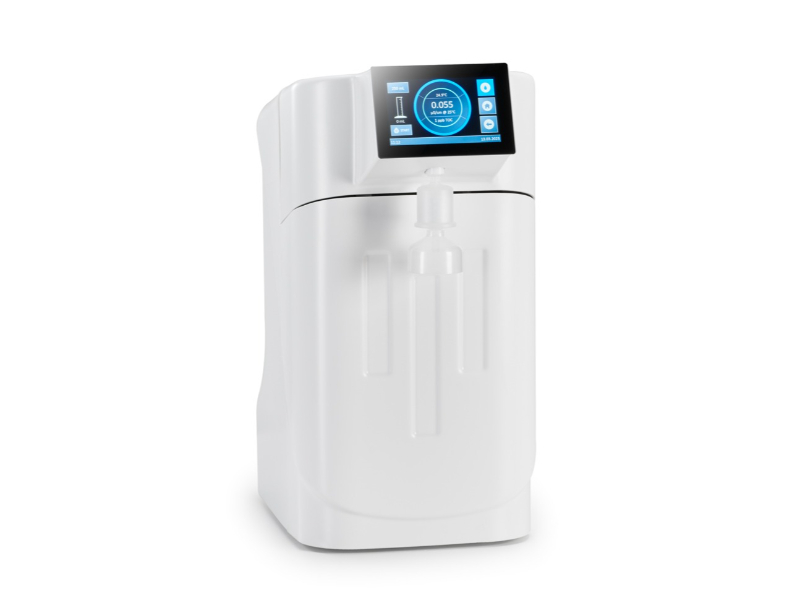
- Product: Type 1 ultrapure water system
- Feed: pre-treated water (RO, DI, EDI or distilled)
- Water quality: 18.2 MΩ·cm / 0.055 µS/cm
- Flow rate: up to 2 L/min
- Dispensing: integrated touchscreen dispenser
€5.324,00 excl. VAT
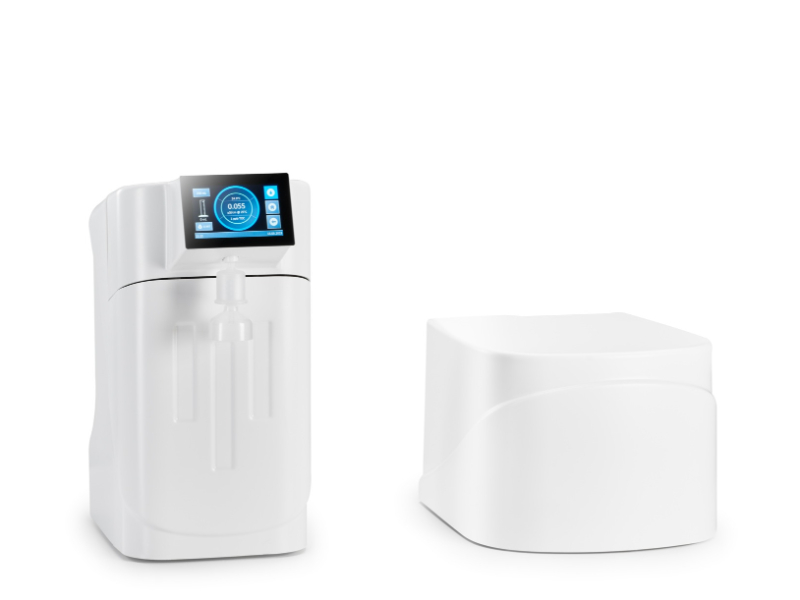
- Product: Type 1 + Type 3 water system
- Feed: potable tap water
- Water quality: 18.2 MΩ·cm ultrapure water + Type 3 pure water
- Production rate: 6 L/h pure water
- Storage volume: 50 L tank
€6.903,00 excl. VAT
- Product: Type 1 + Type 2 water system
- Feed: potable tap water
- Water quality: 18.2 MΩ·cm ultrapure water + Type 2 pure water
- Production rate: 6 L/h pure water
- Storage volume: 10 L tank
€6.903,00 excl. VAT
- Product: Type 1 + Type 3 water system
- Feed: potable tap water
- Water quality: 18.2 MΩ·cm ultrapure water + Type 3 pure water
- Production rate: 12 L/h pure water
- Storage volume: 50 L tank
€7.222,00 excl. VAT
Type 3 Reverse Osmosis Water Systems
ASTM type 3 reverse osmosis water is often used for general lab applications like glassware rinsing, laboratory dishwashers, autoclaves/ steam sterilizers, climate chambers, water baths, … Often reverse osmosis water is also used to feed ultrapure water systems / polishers. The production unit stores the reverse osmosis water in a suitable tank for intermediate storage. Often when a direct connection with pressurized reverse osmosis is required (for example for laboratory dishwasher, autoclaves,…) a booster pump is required.

- Product: laboratory RO production unit (Type 3)
- Feed: tap water (potable water)
- Production rate: 40 L/h RO water
- Storage volume: external tank required
- Pump type: external pump system
€4.835,00 excl. VAT
- Product: laboratory RO water system (Type 3)
- Feed: tap water (potable water)
- Production rate: 6 L/h RO water
- Storage volume: 10 L integrated tank
- Pump type: recirculation pump
€5.135,00 excl. VAT
- Product: laboratory RO water system (Type 3)
- Feed: tap water (potable water)
- Production rate: 12 L/h RO water
- Storage volume: 10 L integrated tank
- Pump type: recirculation pump
€5.445,00 excl. VAT
- Product: Type 1 + Type 3 water system
- Feed: potable tap water
- Water quality: 18.2 MΩ·cm ultrapure water + Type 3 pure water
- Production rate: 6 L/h pure water
- Storage volume: 50 L tank
€6.903,00 excl. VAT
Type 2 Pure Water Systems
DI and EDI water systems (ASTM type 2 pure water) cover a lot of the same applications as reverse osmosis water, but involves an even more advanced purification to cover more applications like pH solutions, buffers, microbiological culture media and clinical analyzer feeding.
- Product: Type 1 + Type 2 water system
- Feed: potable tap water
- Water quality: 18.2 MΩ·cm ultrapure water + Type 2 pure water
- Production rate: 6 L/h pure water
- Storage volume: 10 L tank
€6.903,00 excl. VAT
- Product: Type 1 + Type 2 water system
- Feed: potable tap water
- Water quality: 18.2 MΩ·cm ultrapure water + Type 2 pure water
- Production rate: 12 L/h pure water
- Storage volume: 10 L tank
€7.222,00 excl. VAT
- Product: Type 2 laboratory water system (RO + EDI)
- Feed: tap water (potable water)
- Production rate: 40 L/h
- Storage: external tank connection (optional 50 L tank)
- Pump: external tank pump or distribution system
€8.308,00 excl. VAT

- Product: Type 1 + Type 2 water system
- Feed: potable tap water
- Water quality: 18.2 MΩ·cm ultrapure water + Type 2 pure water
- Production rate: 6 L/h pure water
- Dispensing: integrated adjustable dispenser
€8.815,00 excl. VAT
Type 2 or 3 Central Water Systems
Central water systems are the preferred solution when larger volumes are needed, or when the device needs to feed a central loop in a building. Central systems are constructed of industrial grade components, which allow 24/7 production without any issue. Central systems can be configured as ASTM type 3 reverse osmosis water systems or as type 2 pure water systems (by electro deionization/EDI).

- Product: central laboratory RO water system
- Feed: potable tap water
- Available production volumes: 60, 180, 350, 500, 900 or 1200 L/h
- Storage volume: optional 160 L integrated tank
- Pump type: optional integrated distribution pump
Price on request
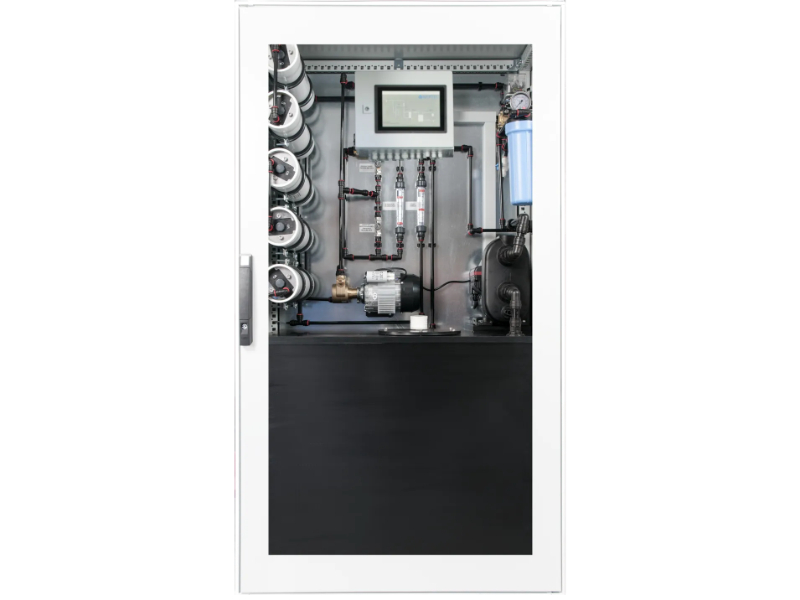
- Product: central laboratory RO water system
- Feed: potable tap water
- Available production volumes: 60, 180, 350 or 500 L/h
- Storage volume: optional 300 L integrated tank
- Pump type: optional integrated distribution pump
Price on request
- Product: central Type 2 laboratory water system (RO + CEDI)
- Feed: potable tap water
- Available production volumes: 60, 180, 350 or 500 L/h
- Storage volume: optional 160 L integrated tank
- Pump type: optional integrated distribution pump
Price on request
- Product: central Type 2 laboratory water system (RO + CEDI)
- Feed: potable tap water
- Available production volumes: 60, 180, 350 or 500 L/h
- Storage volume: optional 300 L integrated tank
- Pump type: optional integrated distribution pump
Price on request
Ion Exchangers
Ion Exchangers use cartridges of mixed bed ion exchange resin to demineralize water (demiwater). They are an economical alternative to reverse osmosis or pure water when ion removal as a sole parameter is sufficient.

- Product: mixed-bed ion exchanger for laboratory deionized water
- Feed: tap water / potable water
- Flow rate: up to 500 L/h
- Capacity: approx. 2500 L at 300 µS/cm feed water
- Water quality: 0.1–20 µS/cm demineralized water
€896,00 excl. VAT
- Product: mixed-bed ion exchanger for laboratory deionized water
- Feed: tap water / potable water
- Flow rate: up to 600 L/h
- Capacity: approx. 2800 L at 300 µS/cm feed water
- Water quality: 0.1–20 µS/cm demineralized water
€1.035,00 excl. VAT
- Product: mixed-bed ion exchanger for laboratory deionized water
- Feed: tap water / potable water
- Flow rate: up to 1000 L/h
- Capacity: approx. 3600 L at 300 µS/cm feed water
- Water quality: 0.1–20 µS/cm demineralized water
€1.324,00 excl. VAT
- Product: mixed-bed ion exchanger for laboratory deionized water
- Feed: tap water / potable water
- Flow rate: up to 1800 L/h
- Capacity: approx. 6000 L at 300 µS/cm feed water
- Water quality: 0.1–20 µS/cm demineralized water
€2.014,00 excl. VAT
- Product: high-capacity mixed-bed ion exchanger for laboratory deionized water
- Feed: tap water / potable water
- Flow rate: up to 2400 L/h
- Capacity: approx. 8400 L at 300 µS/cm feed water
- Water quality: 0.1–20 µS/cm demineralized water
€2.606,00 excl. VAT
- Product: high-capacity mixed-bed ion exchanger for laboratory deionized water
- Feed: tap water / potable water
- Flow rate: up to 2400 L/h
- Capacity: approx. 11000 L at 300 µS/cm feed water
- Water quality: 0.1–20 µS/cm demineralized water
€2.982,00 excl. VAT
- Product: ultra high-capacity mixed-bed ion exchanger for laboratory deionized water
- Feed: tap water / potable water
- Flow rate: up to 2400 L/h
- Capacity: approx. 15000 L at 300 µS/cm feed water
- Water quality: 0.1–20 µS/cm demineralized water
€3.245,00 excl. VAT
Frequently asked questions about pure and ultrapure water systems for laboratories
What is a laboratory water purification system?
A laboratory water purification system is a device that removes contaminants from tap water to produce purified water suitable for lab applications. These systems ensure consistent water quality for use in chemical analysis, life sciences, clinical diagnostics, and general laboratory work
What is the difference between ultrapure water, pure water and reverse osmosis water?
These water types differ in their purity and their applications.
Ultrapure water (also called type 1 or reagent grade water) is the purest water. Ultrapure water is typically used for critical applications like HPLC, ICP, MS, AA, molecular biology and mammalian cell culture.
Pure water (also called type 2, analytical grade, DI or EDI water) is used for standard applications like buffers, pH solutions, bacterial cell culture and clinical analyzers. Pure water can also be used for a lot of the same applications as reverse osmosis water.
Reverse osmosis water (also called type 3, laboratory grade, or RO water) is used for general applications like glassware rinsing, laboratory dishwashers, autoclaves and water baths.
What lab water system do I need for my application?
To chose the best system for your lab water needs, there are a few considerations:
- What applications need laboratory water?
- What water quality is needed for each of the applications?
- How much of each lab water type is needed each day/week/month?
- What is the feed water quality? (Tap water, reverse osmosis water, DI water, EDI water,…)
- How much water is needed per hour, per day or week?
- What are the ambient conditions? Does the lab water system need to be benchtop, wall-mounted, undercounter or free standing?
- Are there any regulatory requirements for the installation? (For example IQ OQ)
With this info, Labman can support you in finding the best solution for your lab water needs.
Can lab water systems be connected to existing lab equipment or automation platforms?
Lab water systems like reverse osmosis or DI water systems produce water that is stored in a pure water tank. Sometimes direct connection to an instrument like a laboratory dishwasher, autoclave (steam sterilizer) or a climatic chamber is required. These instruments need a certain feed water pressure to work optimally. Booster pumps can be connected to the pure water tank to pressurize pure water to the required feed water pressure for the lab equipment.
Labman offers variable frequency booster pumps suitable for the use in laboratories. Also discover our all-in-one undercounter Proteus systems including integrated 80L pure water tank and booster pump.
What is better: DI water or EDI water?
Lab DI water systems use a deionization cartridge on top of the pre-filtration and reverse osmosis step. The deionization cartridge is filled with single use mixed bed resin to further demineralize the water after the reverse osmosis step. Mixed bed resin (a mix of anion exchange resin and cation exchange resin) has the advantage of being a relatively simple and cheap technology. The resin gets saturated, which means the cartridge is typically replaced every year.
Sometimes DI water also refers to ion exchangers, which use mixed bed resin without prefiltration or reverse osmosis. Ion exchangers are a very different technology.
Lab EDI water systems use an electro deionization module to demineralize the water after the reverse osmosis step. Electro deionization uses mixed bed resin in combination with semi permeable membranes and electrodes. The main advantage of EDI vs. DI is that it is a continuous system (self regenerating), which means there is no consumable cost. The disadvantage is that EDI is an expensive technology. EDI is also sensitive to scaling, which means that in most cases softened feed water is required.
In general DI water systems are more interesting for laboratories with lower lab water consumption and EDI water systems are more interesting for laboratories with a high lab water consumption.
Why is high-purity water important in laboratories?
Impurities in lab water can affect test results, damage instruments, and lead to failed experiments. Using the correct purity level ensures accuracy, reliability, and compliance with quality standards.
What is CLRW water and when is it required?
CLRW (Clinical Laboratory Reagent Water) is the standard for water used in clinical diagnostics. It is required for lab tests where precision is critical, ensuring minimal interference from impurities.
Are Neptec lab water systems compliant with international standards
Yes. Neptec GmbH water systems meet international lab water quality standards including:
ASTM Type I, II, III
ISO 3696 Grades 1–3
CLSI CLRW for clinical applications
All systems are manufactured in Germany to the highest engineering standards.
Not sure what pure or ultrapure water purification system suits you best? Get in contact with us for a free consultancy and get the most optimal configuration for your lab needs.