
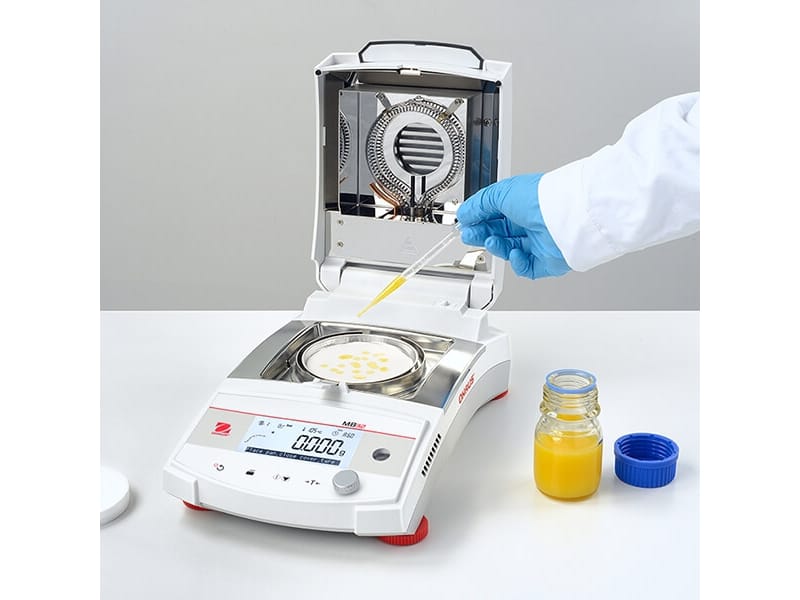
Moisture content plays a critical role in product quality, shelf life, regulatory compliance, and process stability across industries such as food, pharmaceuticals, chemicals, and personal care. One of the most widely used techniques to measure moisture content is Loss on Drying (LOD).
In this article, we explain what LOD is, how thermogravimetric moisture analysis works, and why modern moisture analyzers have become the preferred solution in laboratories and production environments.
What Does “Loss on Drying” Mean?
Loss on Drying (LOD) is a measurement method that determines moisture content by recording the loss of mass when a sample is heated. The assumption is that the reduction in weight is caused primarily by the evaporation of water.
In thermogravimetric moisture analysis, moisture content is defined as the total mass of volatile components lost during heating, expressed as a percentage of the original sample weight. Because volatile substances other than water may evaporate, the correct term is moisture content, not strictly water content
Traditional Oven Method vs Moisture Analyzer
Conventional Oven-Based LOD
Traditionally, LOD measurements were performed using a drying oven and a separate balance. The workflow typically involved:
Weighing the sample on a laboratory balance
Drying it for several hours in an oven
Reweighing the dried sample and manually calculating moisture content
This classical approach is still used in reference methods and standards, often relying on laboratory ovens and laboratory balances, but it has clear disadvantages:
Long analysis times
Higher risk of handling and calculation errors
Limited suitability for routine or in-process measurements
You can still find this equipment-based approach in many QC labs using traditional laboratory ovens and balances.
Thermogravimetric Moisture Analyzers
Modern moisture analyzers automate the entire LOD process by combining:
Precision weighing
Controlled heating
Continuous mass loss monitoring
Automatic moisture calculation
This integrated design allows laboratories to obtain reliable LOD results within minutes instead of hours, with significantly improved repeatability and operator independence.
You can explore different models and technologies on our dedicated moisture analyzers page.
How Does a Moisture Analyzer Measure LOD?
A thermogravimetric moisture analyzer measures moisture content using a simple but highly controlled process:
The sample is weighed automatically inside the instrument
A heating system dries the sample under defined conditions
The instrument continuously monitors weight loss during drying
Moisture content (%) is calculated once a stable endpoint is reached
The measurement ends based on predefined criteria such as time or weight stability, ensuring reproducible results across samples and operators.
Heating Technologies and Their Impact on LOD Results
The heating technology used in a moisture analyzer has a direct influence on speed, accuracy, and repeatability.
Halogen Heating
Halogen heating is widely used for thermogravimetric moisture analysis because it offers:
Rapid heat-up times
Precise temperature control
Short overall analysis time
Compared to conventional infrared systems, halogen heating can reduce drying time by up to 40%.
Carbon Fiber Heating (Next-Generation Systems)
Newer moisture analyzers use carbon fiber heating technology, which provides:
Faster and more uniform heat distribution
Improved energy efficiency
Greater consistency between measurements
This technology is particularly valuable in high-throughput laboratories and production environments where speed and reproducibility are critical
Why Sample Preparation Is Critical for Accurate LOD Results
Even with advanced instrumentation, correct sample preparation remains essential. Best practices include:
Using a representative, homogeneous sample
Distributing the material in a thin, even layer
Preventing moisture gain or loss during preparation
Selecting an appropriate sample size, typically between 5 and 10 grams
Incorrect sample distribution or inconsistent preparation is one of the most common causes of poor repeatability in LOD measurements
Typical Applications of Loss on Drying
LOD moisture analysis is used across a wide range of industries, including:
Food and beverage production
Pharmaceutical manufacturing
Cosmetics and personal care
Animal feed and agriculture
Chemical and material processing
For each application, drying temperature, heating profile, and shut-off criteria must be optimized to achieve reliable and meaningful results.
Choosing the Right Equipment for Moisture Analysis
When selecting equipment for moisture determination, laboratories typically choose between:
Traditional setups using laboratory ovens and laboratory balances
Integrated thermogravimetric moisture analyzers
For routine QC, production control, and fast decision-making, moisture analyzers offer clear advantages in speed, ease of use, and reproducibility. Modern systems also support method storage, data security, and compliance with quality systems such as GLP or ISO
Learn More About Moisture Analyzers
Understanding Loss on Drying is essential when selecting the right solution for moisture determination. If you are comparing technologies or upgrading from oven-based methods, you can explore our full range of moisture analyzers to find the most suitable model for your laboratory or production environment.