
Central Laboratory Water Systems
Central laboratory water systems provide purified water to multiple laboratories or departments via a closed recirculation loop. They ensure stable water quality, high flow capacity and continuous availability for universities, hospitals and industrial research facilities.

- Product: central laboratory RO water system
- Feed: potable tap water
- Available production volumes: 60, 180, 350, 500, 900 or 1200 L/h
- Storage volume: optional 160 L integrated tank
- Pump type: optional integrated distribution pump
€17.000,00 excl. VAT
- Product: central Type 2 laboratory water system (RO + CEDI)
- Feed: potable tap water
- Available production volumes: 60, 180, 350 or 500 L/h
- Storage volume: optional 160 L integrated tank
- Pump type: optional integrated distribution pump
€25.000,00 excl. VAT
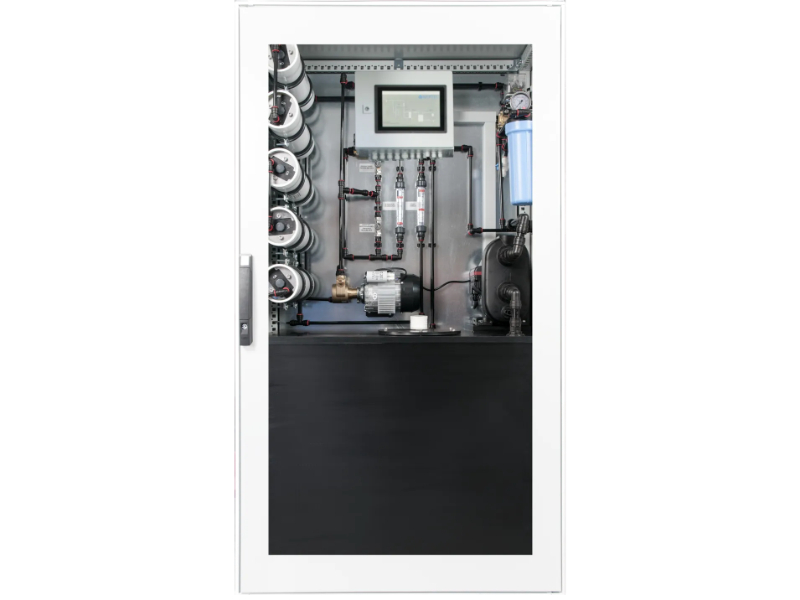
- Product: central Type 2 laboratory water system (RO + CEDI)
- Feed: potable tap water
- Available production volumes: 60, 180, 350 or 500 L/h
- Storage volume: optional 300 L integrated tank
- Pump type: optional integrated distribution pump
€30.000,00 excl. VAT
- Product: central laboratory RO water system
- Feed: potable tap water
- Available production volumes: 60, 180, 350 or 500 L/h
- Storage volume: optional 300 L integrated tank
- Pump type: optional integrated distribution pump
€20.000,00 excl. VAT
When to Choose a Central Laboratory Water System
| Scenario | Individual Systems | Central System |
|---|---|---|
| Multiple laboratories on one floor | Separate units per lab | One production unit, multiple distribution points |
| High daily water demand | Limited capacity | Designed for large volumes |
| Quality monitoring | Local monitoring only | Centralized continuous monitoring |
| Redundancy | Rarely implemented | Optional dual production units |
| Future expansion | Limited scalability | Easily expandable |
Conclusion: When several laboratories require stable, high-volume purified water, a central system is technically and economically advantageous.
What is a Central Laboratory Water System?
A central laboratory water system produces purified water at a single location and distributes it via a closed-loop recirculation network to multiple points of use. This approach is common in universities, hospital laboratories, pharmaceutical production sites and large R&D facilities throughout the BeNeLux region.
Recirculation Loop Principle
Unlike static piping systems, a recirculation loop ensures constant water movement, which helps to:
- Prevent stagnation
- Reduce microbiological growth
- Maintain stable resistivity levels
- Deliver consistent quality at every outlet
Available Water Grades
Central systems can be configured to produce:
Buffer Storage and Flow Management
Storage tanks allow peak demand management and ensure constant pressure throughout the building. This is critical when multiple laboratories operate simultaneously.
Redundancy and Operational Security
In hospital or pharmaceutical environments, redundant production units can be installed to avoid downtime. Continuous monitoring of resistivity, flow and system status ensures operational reliability.
Project-Based Engineering in the BeNeLux
Central systems require detailed planning, including:
- Water demand analysis (L/day and peak L/hour)
- Material selection (PVDF or stainless steel piping)
- Integration with building infrastructure
- Validation documentation when required
Compatible Laboratory Equipment
Central systems often supply clinical analyzers, laboratory glassware washers (page coming soon) and constant climate chambers to ensure consistent water quality across all equipment.
Solutions for Research and Healthcare Facilities
Universities, hospitals and industrial laboratories in Belgium, the Netherlands and Luxembourg rely on central water systems to guarantee scalability, reliability and regulatory compliance.
Typical Water Grades in Central Systems
Central laboratory water systems most commonly produce Type 2 water using RO-EDI technology. This configuration provides a stable, high-quality feed water suitable for distribution through storage tanks and recirculation loops.
- Type 2 Pure Water (RO-EDI) – most common and stable central configuration
- Type 3 RO Water – bulk production for technical applications
- CLRW / CLSI Water – for clinical analyzers
Important: Type 1 ultrapure water is typically produced at the point of use rather than centrally. Due to its very high purity, it is highly aggressive and can quickly lose quality when stored in tanks or distributed through piping systems.