
80 kHz Ultrasonic Cleaners for Precision Cleaning
80 kHz ultrasonic cleaners are designed for high-precision cleaning of delicate laboratory and electronic components.
The higher ultrasonic frequency generates smaller cavitation bubbles, providing finer and more uniform cleaning action with enhanced surface protection.
These systems are ideal for optics, electronics, micro-components and sensitive materials requiring controlled cavitation.
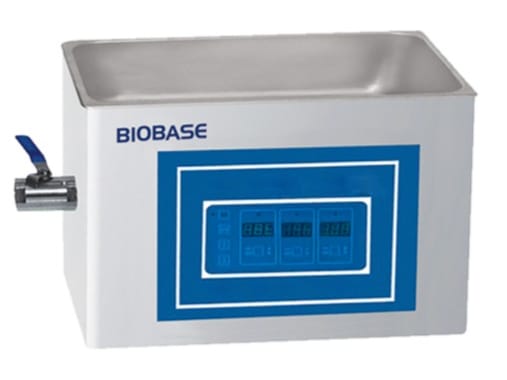
- Type: Single frequency 80 kHz ultrasonic cleaner
- Volume: 4 L tank capacity
- Ultrasonic Power: 100 W
- Heating Power: 400 W
- Tank Size: 300 × 150 × 100 mm
€1.075,00 excl. VAT
- Type: Single frequency 80 kHz ultrasonic cleaner
- Volume: 6 L tank capacity
- Ultrasonic Power: 200 W
- Heating Power: 400 W
- Tank Size: 300 × 150 × 150 mm
€1.575,00 excl. VAT
- Type: Single frequency 80 kHz ultrasonic cleaner
- Volume: 8 L tank capacity
- Ultrasonic Power: 200 W
- Heating Power: 400 W
- Tank Size: 300 × 150 × 180 mm
€1.750,00 excl. VAT
- Type: Single frequency 80 kHz ultrasonic cleaner
- Volume: 10 L tank capacity
- Ultrasonic Power: 300 W
- Heating Power: 400 W
- Tank Size: 300 × 240 × 150 mm
€2.037,00 excl. VAT
- Type: Single frequency 80 kHz ultrasonic cleaner
- Volume: 13 L tank capacity
- Ultrasonic Power: 300 W
- Heating Power: 400 W
- Tank Size: 300 × 240 × 180 mm
€4.820,00 excl. VAT
- Type: Single frequency 80 kHz ultrasonic cleaner
- Volume: 27 L tank capacity
- Ultrasonic Power: 500 W
- Heating Power: 500 W
- Tank Size: 500 × 300 × 180 mm
€7.220,00 excl. VAT
How 80 kHz Compares to 40 kHz and 28 kHz
| Frequency | Cavitation Intensity | Best For | Surface Protection |
|---|---|---|---|
| 28 kHz | High | Heavy industrial contamination | Moderate |
| 40 kHz | Balanced | General laboratory cleaning | Good |
| 80 kHz | Fine and controlled | Optics, electronics, precision parts | Excellent |
80 kHz ultrasonic cleaners provide the highest level of surface protection while maintaining effective contaminant removal.
Why Choose 80 kHz Ultrasonic Cleaning?
At 80 kHz, ultrasonic cleaners generate smaller cavitation bubbles compared to 40 kHz or 28 kHz systems. These smaller bubbles create a more refined and evenly distributed cleaning action.
This reduces the risk of surface erosion and micro-damage, making 80 kHz ideal for delicate and high-value components.
Applications for 80 kHz Precision Cleaning
- Optical lenses and components
- Electronic circuit boards
- Micro-mechanical parts
- Precision laboratory instruments
- Medical and diagnostic components
The finer cavitation effect allows penetration into narrow channels and complex geometries without aggressive surface impact.
When Not to Use 80 kHz
For heavily contaminated industrial components or thick grease layers, lower frequencies such as 28 kHz may provide stronger cleaning action. 80 kHz is optimized for precision and surface protection rather than maximum cavitation intensity.
Integrated Heating and Digital Control
Most 80 kHz ultrasonic cleaners include digital timers and integrated heating up to 80°C. Heating enhances removal of oils and residues while maintaining precise control over cleaning cycles.
Combining fine cavitation with controlled temperature ensures reproducible and high-quality cleaning results.
Explore Related Ultrasonic Cleaning Solutions and bath types
- 40 kHz Ultrasonic Cleaners – Standard laboratory cleaning applications
- 40 kHz Ultrasonic Cleaners with Adjustable Power – Enhanced cavitation control
- 28/40 kHz Dual Frequency Ultrasonic Cleaners – Flexible cleaning intensity for varied contamination
- Laboratory Water Baths & Circulators – Temperature-controlled sample conditioning
- Lab Armor Bead Baths – Waterless temperature stabilization
- Laboratory Dishwashers – Automated glassware washing systems
Selecting the correct ultrasonic frequency ensures optimal cleaning performance while protecting sensitive laboratory and industrial components.