
28/40 kHz Dual Frequency Ultrasonic Cleaners
28/40 kHz dual frequency ultrasonic cleaners provide maximum flexibility by allowing users to switch between two cleaning intensities.
The 28 kHz setting delivers stronger cavitation for heavy contamination, while 40 kHz offers balanced cleaning for routine laboratory applications.
This dual-frequency capability makes these systems ideal for laboratories and technical environments handling diverse materials and contamination levels.
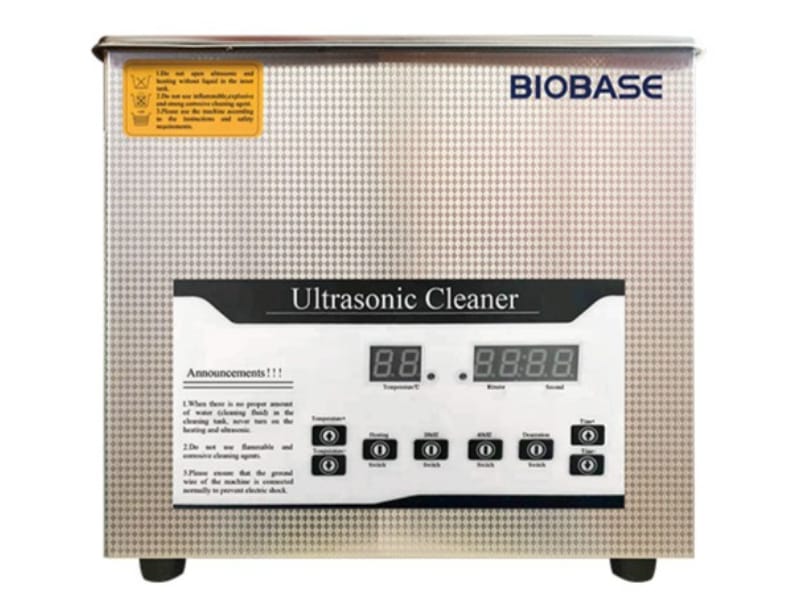
- Type: Dual frequency 28/40 kHz ultrasonic cleaner
- Volume: 6.5 L tank capacity
- Ultrasonic Power: 180 W
- Heating Power: 500 W
- Tank Size: 300 × 150 × 150 mm
€495,00 excl. VAT
- Type: Dual frequency 28/40 kHz ultrasonic cleaner
- Volume: 10 L tank capacity
- Ultrasonic Power: 240 W
- Heating Power: 500 W
- Tank Size: 300 × 240 × 150 mm
€600,00 excl. VAT
- Type: Dual frequency 28/40 kHz ultrasonic cleaner
- Volume: 15 L tank capacity
- Ultrasonic Power: 360 W
- Heating Power: 500 W
- Tank Size: 330 × 300 × 150 mm
€750,00 excl. VAT
- Type: Dual frequency 28/40 kHz ultrasonic cleaner
- Volume: 22.5 L tank capacity
- Ultrasonic Power: 480 W
- Heating Power: 500 W
- Tank Size: 500 × 300 × 150 mm
€840,00 excl. VAT
- Type: Dual frequency 28/40 kHz ultrasonic cleaner
- Volume: 30 L tank capacity
- Ultrasonic Power: 600 W
- Heating Power: 500 W
- Tank Size: 500 × 300 × 200 mm
€960,00 excl. VAT
28 kHz vs 40 kHz – Dual Frequency Explained
| Frequency | Cleaning Strength | Best For | Surface Protection |
|---|---|---|---|
| 28 kHz | High cavitation intensity | Heavy grease, industrial residues | Moderate |
| 40 kHz | Balanced cavitation | Laboratory glassware and instruments | Good |
Dual frequency ultrasonic cleaners combine both options in a single system, allowing process optimization for each cleaning task.
What Is Dual Frequency Ultrasonic Cleaning?
Dual frequency ultrasonic cleaners allow users to select between two different ultrasonic frequencies within the same unit. This provides flexibility when handling varying contamination levels or different material sensitivities.
The Advantage of 28 kHz for Heavy Contamination
At 28 kHz, cavitation bubbles are larger and collapse with greater intensity. This makes it highly effective for removing heavy grease, industrial residues and stubborn contamination.
Lower frequencies are particularly useful in technical workshops and industrial maintenance environments.
The Role of 40 kHz in Laboratory Cleaning
40 kHz remains the standard laboratory frequency, offering a balanced cleaning action suitable for glassware, instruments and metal components.
Switching between 28 kHz and 40 kHz allows laboratories to optimize cleaning intensity depending on the application.
When to Choose Dual Frequency Systems
- Laboratories handling diverse contamination levels
- Industrial and research crossover applications
- Facilities requiring process optimization
- Cleaning both robust and sensitive components
Integrated Heating and Digital Process Control
Most dual frequency ultrasonic cleaners include digital timers and integrated heating up to 80°C. Heating enhances removal of oils and organic residues while frequency selection provides cavitation control.
This combination ensures both cleaning power and material protection.
Explore Other Ultrasonic Cleaning Solutions
- 40 kHz Ultrasonic Cleaners – Standard laboratory cleaning systems
- 40 kHz Ultrasonic Cleaners with Adjustable Power – Enhanced control for delicate applications
- 80 kHz Ultrasonic Cleaners – Precision cleaning for sensitive components
- Laboratory Water Baths & Circulators – Temperature-controlled sample conditioning
- Lab Armor Bead Baths – Waterless temperature stabilization
- Laboratory Dishwashers – Automated glassware washing systems
Combining ultrasonic cleaning with proper washing and conditioning equipment improves laboratory workflow efficiency and reproducibility.