
Vacuum Desiccators
Vacuum desiccators are the preferred solution for faster drying and reliable dry storage of moisture-sensitive laboratory materials.
By reducing the internal pressure with an external vacuum pump, moisture is removed more efficiently than with standard atmospheric desiccators.
Labman Instruments supplies Jeiotech vacuum desiccators across Europe in round, cubic and cylindrical formats, including models with integrated vacuum gauge and UV-blocking options for light-sensitive samples.
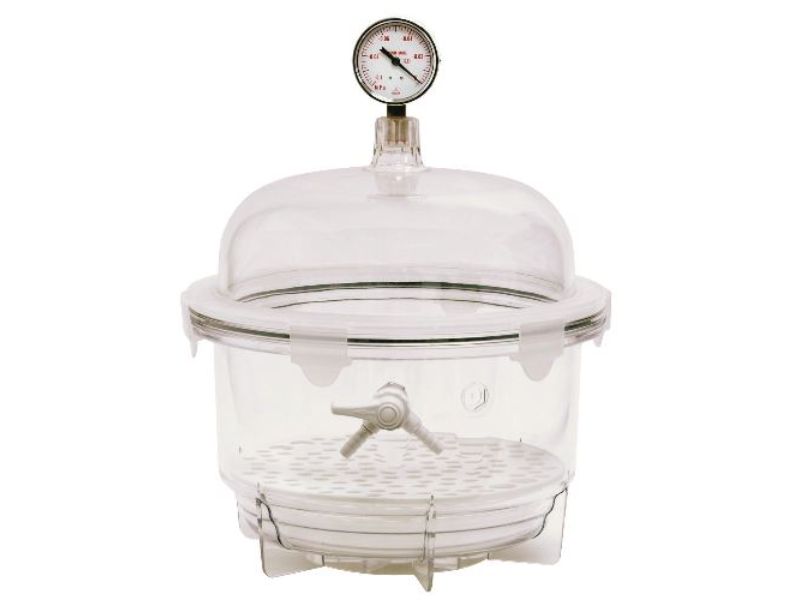
- Type: Clear, round
- Vacuum level: Up to 1 Torr for 72 hours
- Internal volume: 6 L
- Body material: Polycarbonate (transparent)
- Highlights: Analog gauge, UV-blocking option
€480,00 excl. VAT
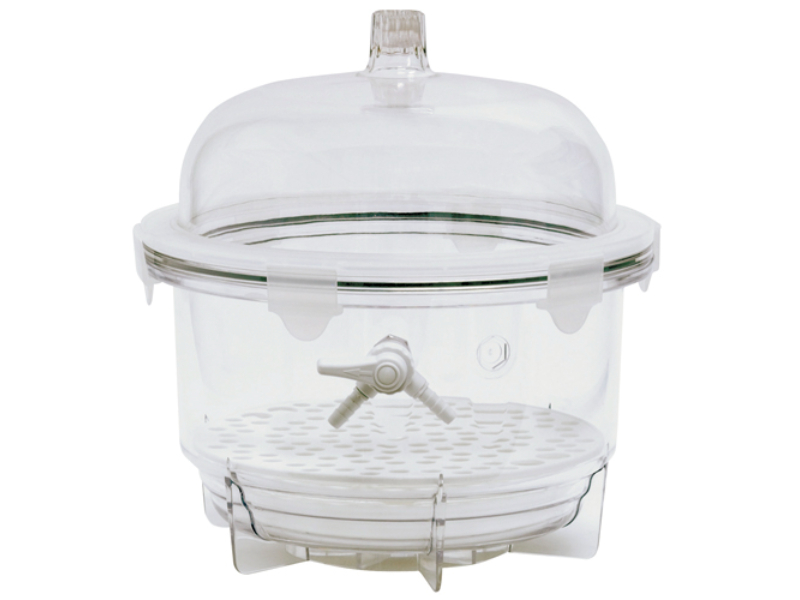
- Type: Clear, round
- Vacuum level: Up to 1 Torr for 72 hours
- Internal volume: 10 L
- Body material: Polycarbonate (transparent)
- Highlights: UV-blocking option, optional vacuum gauge
€432,00 excl. VAT
- Type: Clear, round
- Vacuum level: Up to 1 Torr for 72 hours
- Internal volume: 10 L
- Body material: Polycarbonate (transparent)
- Highlights: Analog gauge, UV-blocking option
€525,00 excl. VAT
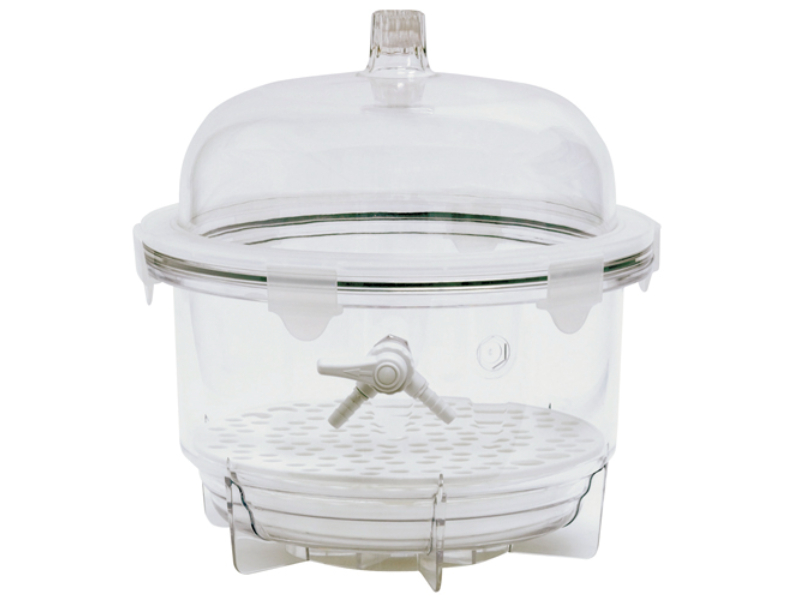
- Type: Clear, round
- Vacuum level: Up to 1 Torr for 72 hours
- Internal volume: 20L
- Body material: Polycarbonate (transparent)
- Highlights: UV-blocking option, optional vacuum gauge
€500,00 excl. VAT
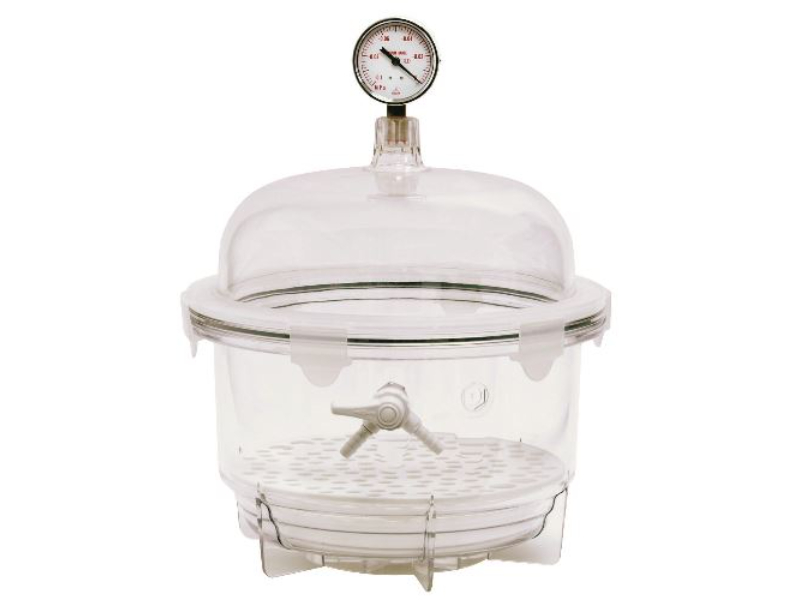
- Type: Clear, round
- Vacuum level: Up to 1 Torr for 72 hours
- Internal volume: 20 L
- Body material: Polycarbonate (transparent)
- Highlights: Analog gauge, UV-blocking option
€600,00 excl. VAT
Round vs cubic vs cylindrical vacuum desiccators
All vacuum desiccators operate with an external vacuum pump, but the cabinet shape impacts capacity, sample organization and bench space efficiency. Use the guide below to choose the best format for your lab workflow.
Quick comparison overview
| Feature | Round vacuum desiccator | Cubic vacuum desiccator | Cylindrical vacuum desiccator |
|---|---|---|---|
| Best advantage | Compact footprint | Space efficient capacity & multi-tray use | Very compact vertical form |
| Sample organization | Basic (single main platform) | Excellent (multiple perforated trays) | Limited (compact internal layout) |
| Stackable | Typically no | Yes (stackable models) | Typically no |
| Typical use-case | Routine vacuum drying | High throughput or organized storage | Bench space is extremely limited |
| Visibility | Transparent body | Transparent body | Transparent body |
When to choose each format
- Round: choose for compact routine drying when you prefer a classic round chamber shape.
- Cubic: choose when you need better internal organization, multiple trays and maximum space efficiency.
- Cylindrical: choose when bench space is extremely limited and volumes are modest.
Vacuum desiccators for fast drying and critical moisture protection
Vacuum desiccators are used for drying and storing samples that are highly sensitive to moisture.
Compared to atmospheric desiccators, vacuum conditions accelerate moisture removal and help maintain stable, dry storage conditions for critical applications in R&D, QA/QC and production environments.
The Jeiotech vacuum desiccator range covers different formats and volumes, allowing you to match the cabinet design to your lab workflow.
Round models are compact and ideal for routine applications, while cubic models are more space-efficient and support multi-tray organization for higher sample throughput.
For highly space-constrained benches, cylindrical models provide a compact alternative.
Typical applications
- Drying hygroscopic chemicals, powders and reagents
- Moisture-sensitive samples in pharmaceutical and QA/QC labs
- Electronics and micro-components requiring dry storage
- General vacuum experiments and moisture protection workflows
Need advice on the best format and volume? Share your sample size, throughput, and target conditions, and Labman Instruments will help you select the most suitable vacuum desiccator model for your lab across Europe.
When to use a vacuum oven instead of a vacuum desiccator
Vacuum desiccators are ideal for moisture protection and faster drying at ambient temperature.
If your process requires controlled temperature drying under reduced pressure, a vacuum oven is often the better choice.
- Vacuum desiccator: moisture protection and vacuum drying without active heating.
- Vacuum oven: combines heat + vacuum for faster, low-temperature drying and process consistency.
- Laboratory oven: temperature drying at ambient pressure for routine applications.
- Incubator: gentle temperature conditioning for sensitive samples.
- Constant climate chamber: controlled temperature and humidity for conditioning and stability workflows.
Choose vacuum desiccators when humidity is the main concern. Choose vacuum ovens when drying speed and controlled temperature are both required.