
Auto-Desiccator Cabinets
Auto-desiccator cabinets provide electronically controlled humidity storage for moisture-sensitive laboratory and industrial materials. Unlike standard desiccators, these cabinets maintain a stable RH setpoint without the need for silica gel.
Labman Instruments supplies Jeiotech auto-desiccator cabinets across Europe, offering reliable long-term dry storage for laboratories, electronics production, and high-value sample protection.
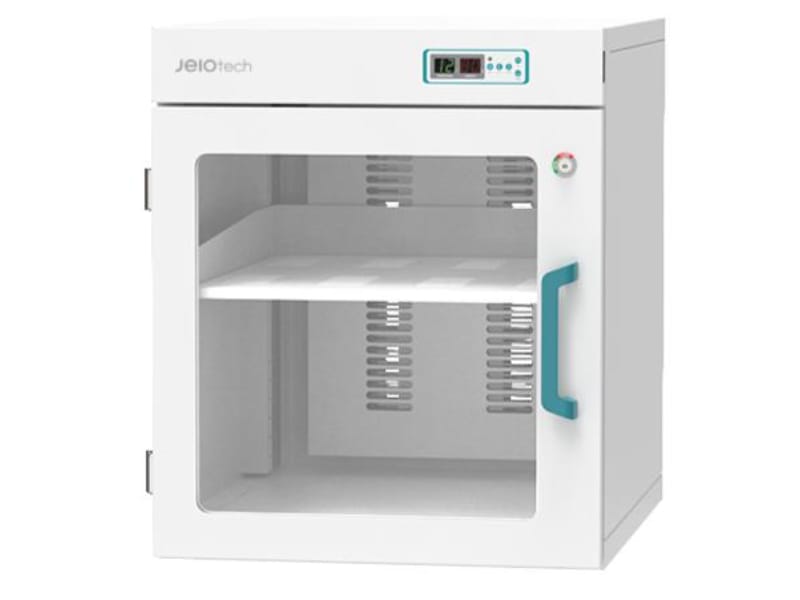
- 120 L internal volume
- 20–60% RH humidity setting (1% resolution)
- Compact and stackable design
- 2 shelves standard (max. 4)
- Optional anti-static (ESD) version
€3.843,00 excl. VAT
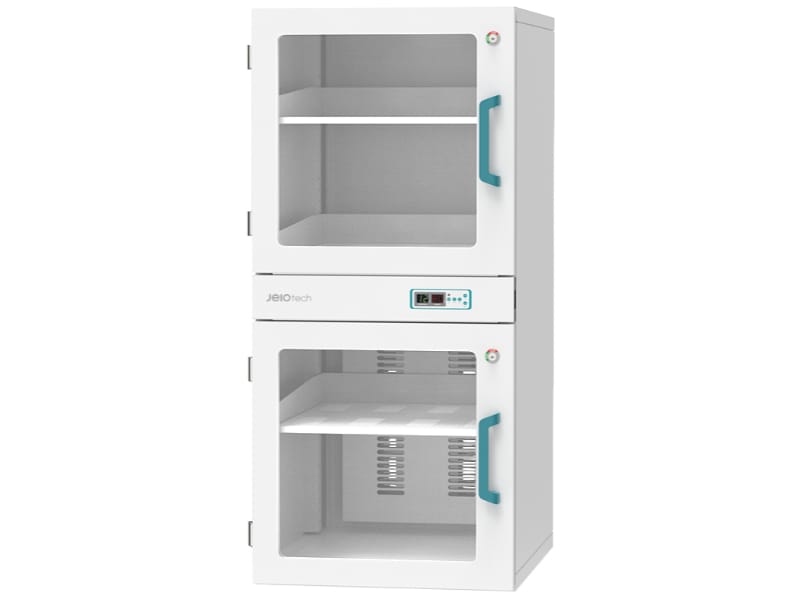
- 240 L internal volume
- 20–60% RH humidity setting (1% resolution)
- Dual-door configuration
- 4 shelves standard (max. 8)
- Optional anti-static (ESD) version
€4.694,40 excl. VAT
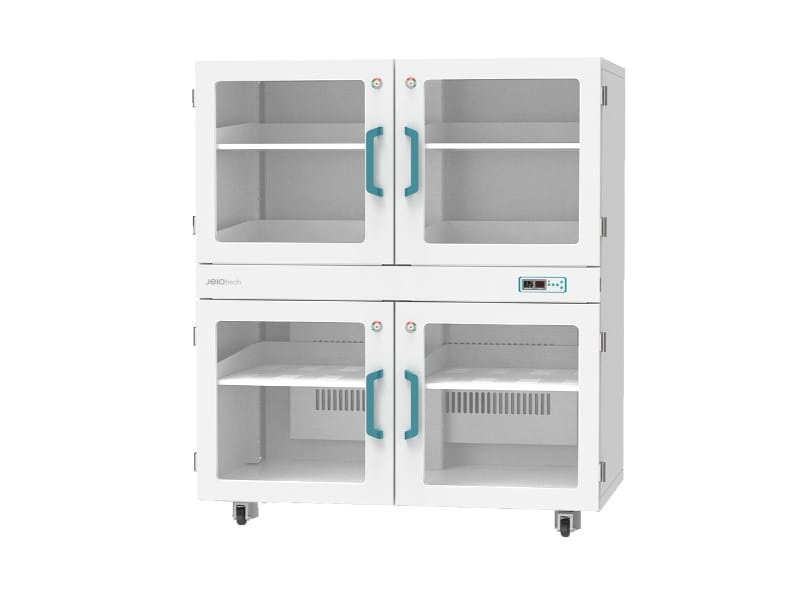
- 480 L internal volume
- 20–60% RH humidity setting (1% resolution)
- 4-door large capacity cabinet
- 8 shelves standard (max. 16)
- Optional anti-static (ESD) version
€6.804,00 excl. VAT
Auto-desiccator cabinet vs vacuum desiccator vs atmospheric desiccator
Auto-desiccator cabinets are designed for stable long-term humidity control. If your workflow requires rapid drying or simple passive storage, other desiccator types may be more suitable.
Quick comparison overview
| Feature | Auto-desiccator cabinet | Vacuum desiccator | Atmospheric desiccator |
|---|---|---|---|
| Pressure control | No (ambient pressure) | Yes (vacuum with pump) | No (ambient pressure) |
| Humidity control | Active electronic RH control | Passive + vacuum | Passive (desiccant) |
| RH stability | High precision setpoint control | Depends on vacuum + desiccant | Depends on desiccant condition |
| Maintenance | Minimal manual handling | Pump maintenance + seals | Replace/regenerate desiccant |
| Best suited for | Long-term controlled storage | Fast drying of critical samples | Routine dry storage |
Best use-cases for auto-desiccator cabinets
- Long-term storage of moisture-sensitive laboratory samples
- Electronics, semiconductor and optical components
- Industrial materials requiring stable humidity conditions
- Applications where manual silica gel replacement is undesirable
Electronically controlled humidity storage for laboratories and industry
Auto-desiccator cabinets are advanced dry storage solutions designed to maintain a stable and controlled relative humidity level inside the chamber.
Unlike traditional desiccators that rely on passive silica gel, these cabinets use an integrated electronic dry unit to regulate humidity continuously.
This makes them particularly suitable for long-term storage of moisture-sensitive materials such as laboratory samples, IC components, optical devices, precision instruments, and industrial materials.
The controlled RH range typically allows users to select specific humidity levels depending on application requirements.
Why choose an auto-desiccator cabinet?
- Stable and consistent humidity control without desiccant replacement
- Large storage volumes (ideal for high-capacity storage)
- Suitable for laboratory, industrial and electronics environments
- Reduced maintenance compared to passive desiccator systems
For applications requiring faster moisture removal rather than stable storage, a vacuum desiccator may be more appropriate.
For simpler routine dry storage at lower cost, atmospheric desiccators remain an effective alternative.
Alternative solutions for drying and humidity control
Auto-desiccator cabinets are ideal for stable long-term humidity control. Depending on your process requirements, other solutions may be more suitable:
- Vacuum desiccators: for accelerated drying under reduced pressure.
- Atmospheric desiccators: simple passive dry storage using desiccant.
- Laboratory ovens: temperature drying for routine laboratory processes.
- Vacuum ovens: heat + vacuum for faster and low-temperature drying.
- Constant climate chambers: programmable temperature and humidity conditioning.
Selecting the correct solution depends on whether your priority is drying speed, humidity stability, storage volume, or operational simplicity.