
Moisture is one of the most common (and underestimated) causes of sample degradation, unstable results, and premature failure of sensitive materials.
In laboratories and technical environments, “dry storage” can mean very different things: passive desiccant storage, vacuum-assisted drying, or actively controlled humidity storage.
This guide explains the practical differences between standard desiccators, vacuum desiccators, and electronic auto-desiccator cabinets,
and clarifies when a vacuum oven or laboratory drying oven is the better choice.
If you want an overview of our full range, start here:
Laboratory desiccators & vacuum desiccators.
1) What does a desiccator actually do?
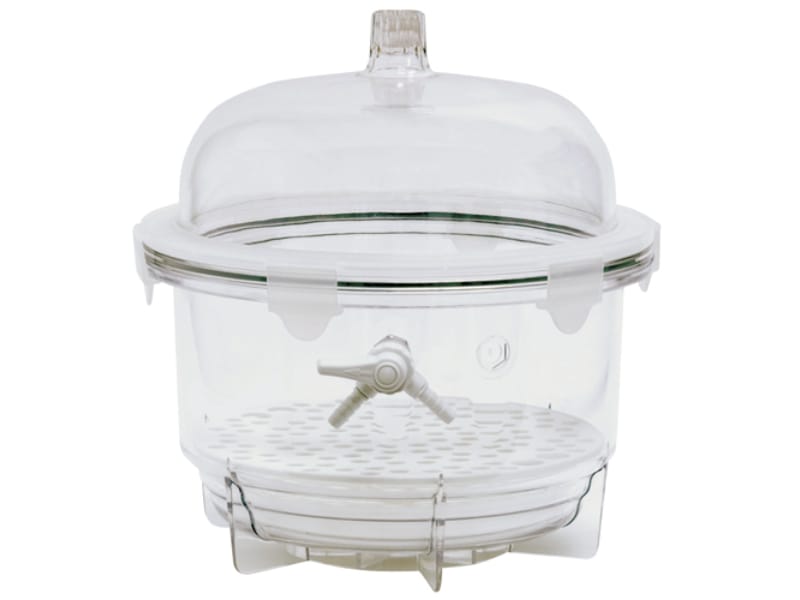
A desiccator is a sealed storage enclosure designed to reduce (or stabilize) humidity around moisture-sensitive materials.
It protects samples, reagents, components, and instruments from ambient moisture uptake during storage, handling, or conditioning.
- Standard desiccators reduce humidity passively using a desiccant (e.g., silica gel).
- Vacuum desiccators accelerate moisture removal by lowering pressure.
- Auto-desiccator cabinets actively regulate relative humidity (RH) electronically for stable long-term storage.
2) Quick decision guide (most common lab scenarios)
- Routine dry storage (no vacuum required): choose a standard desiccator.
- Faster moisture removal / sensitive or reactive materials: choose a vacuum desiccator.
- Stable RH for long-term storage (no desiccant handling): choose an auto-desiccator cabinet.
- Temperature-based drying is required: choose a laboratory oven or vacuum oven (not a desiccator).
Browse the product groups here:
Desiccators & vacuum desiccators overview
Laboratory drying ovens overview
3) Standard desiccators (atmospheric pressure): simple, reliable dry storage
Standard desiccators are ideal when you need basic moisture protection and visual sample access without vacuum equipment.
They are widely used for routine storage of hygroscopic materials, optical components, reference standards, and general laboratory samples.
Choose standard desiccators when you need:
- Simple dry storage at atmospheric pressure
- Low maintenance and straightforward operation
- Good visibility and easy access for routine workflows
- Optional UV protection for light-sensitive materials
For the complete selection (standard + UV-protected models), see:
our desiccator range.
4) Vacuum desiccators: faster moisture removal under reduced pressure
Vacuum desiccators are chosen when atmospheric dry storage is not sufficient.
Reducing pressure accelerates evaporation and supports faster moisture removal, especially for more demanding workflows.
They are also useful when handling materials that are particularly moisture-sensitive or when you want a controlled environment.
Choose vacuum desiccators when you need:
- Faster drying compared to atmospheric desiccators
- Improved moisture removal for sensitive or reactive materials
- Vacuum-assisted conditioning without applying heat
- Compatibility with external vacuum pumps and (often) vacuum gauges
Explore vacuum desiccator configurations (round, cubic, cylindrical):
vacuum desiccators overview.
5) Auto-desiccator cabinets: stable RH storage without desiccant replacement
Auto-desiccator cabinets are designed for users who need controlled relative humidity without manual desiccant handling and without vacuum.
Instead of passive moisture absorption, these cabinets use an internal electronic drying system to stabilize RH at a set level.
Choose auto-desiccator cabinets when you need:
- Stable, repeatable RH conditions for long-term storage
- Minimal day-to-day maintenance (no silica gel replacement workflow)
- Protection for electronics, PCB’s, optical instruments, and moisture-sensitive samples
- Higher storage capacity compared to benchtop desiccators
See the available auto-desiccator cabinet models:
auto-desiccator cabinet overview.
6) Desiccator vs vacuum oven: when is a vacuum oven the better choice?
A desiccator mainly supports dry storage and (in vacuum models) vacuum-assisted moisture removal—typically without controlled heating.
When you need temperature-driven drying, a vacuum oven or laboratory oven is usually the correct tool.
Choose a vacuum oven when:
- You need drying under vacuum with temperature for process efficiency
- Materials are heat-sensitive but still require controlled thermal drying
- You want faster removal of solvents by lowering boiling point under reduced pressure
Learn more about vacuum ovens here:
Vacuum ovens for laboratory drying.
Choose a laboratory drying oven when:
- You need consistent temperature drying at atmospheric pressure
- Your workflow involves drying glassware, instruments, or robust samples
See our laboratory oven range:
Laboratory ovens for drying.
7) When incubators or constant climate chambers are the better fit
If your goal is not “dry storage” but rather controlled conditioning of samples, other equipment categories may be more suitable.
- Laboratory incubators: for gentle, stable temperature conditions where humidity control is not the primary driver.
View laboratory incubators. - Constant climate chambers: when both temperature and RH must be controlled precisely for stability studies or conditioning.
View constant climate chambers.
8) Quick comparison overview
| Feature | Standard desiccator | Vacuum desiccator | Auto-desiccator cabinet | Vacuum oven |
|---|---|---|---|---|
| Main purpose | Dry storage | Faster moisture removal | Stable RH storage | Vacuum + thermal drying |
| Pressure control | No | Yes | No | Yes |
| Humidity control | Passive (desiccant) | Passive + vacuum | Active electronic RH control | Process-driven (vacuum + heat) |
| Maintenance | Replace desiccant | Pump / vacuum line checks | Minimal | Process maintenance + validation workflows |
| Best for | Routine lab storage | Demanding drying / conditioning | Long-term stable RH storage | Controlled drying with heat |
FAQ: common questions from laboratories
Is a desiccator the same as a drying oven?
No. A desiccator is mainly for dry storage (and sometimes vacuum-assisted moisture removal), while an oven is for temperature-based drying.
If you need controlled heat, consider a laboratory oven or a vacuum oven.
When should I choose a vacuum desiccator instead of a vacuum oven?
Choose a vacuum desiccator if you want vacuum-assisted moisture removal without adding heat, or if your workflow is primarily storage/conditioning.
Choose a vacuum oven when temperature-controlled drying under vacuum is required.
When does an auto-desiccator cabinet make sense?
If you need stable RH conditions for long-term storage (especially for electronics, optical instruments, or humidity-sensitive materials) and you want to avoid
desiccant replacement workflows, an auto-desiccator cabinet is usually the best fit.
Need help selecting the right model?
If you tell us your application (storage vs drying), target humidity level, and required volume, we can recommend the right desiccator solution for your lab.
Start with the full overview and model groups here:
Laboratory desiccators & vacuum desiccators.