
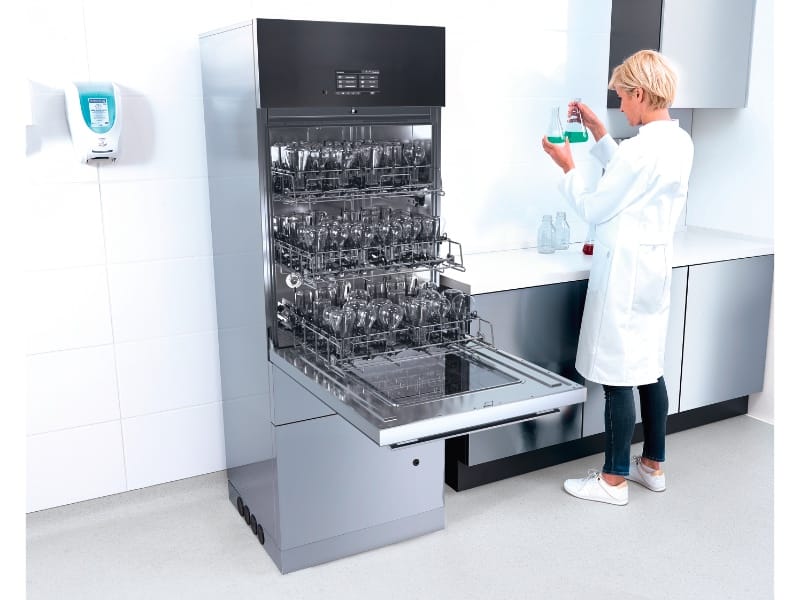
Laboratory dishwashers, also called laboratory glassware washers, rely heavily on water quality to ensure reproducible cleaning results, prevent residues, and protect sensitive analytical workflows. Choosing the right lab water type for the final rinse is therefore just as important as selecting the dishwasher itself.
In this article, we explain:
Which water types laboratory dishwashers use
The differences between demineralized water, reverse osmosis (Type III), and pure water (Type II)
Which solution is best for your lab, based on usage, cost, and application
This guide is especially relevant for users of Miele laboratory dishwashers, which are widely used in pharmaceutical, chemical, and research laboratories across the BeNeLux.
How Laboratory Dishwashers Use Water
Laboratory dishwashers run multi-step programs consisting of several phases:
Pre-wash and main wash
Uses softened municipal tap waterIntermediate rinses
Removes detergent residuesFinal (after) rinse
Uses purified laboratory water
The after rinse is critical. Poor water quality at this stage can leave ionic residues, spots, or organic contamination, directly impacting analytical results.
How Much Purified Water Does a Laboratory Dishwasher Consume?
Laboratory dishwashers are often the largest purified water consumers in a lab.
As an example:
A standard universal program on a Miele laboratory dishwasher consumes approximately 18.5 litres of purified water per cycle
Multiple cycles per day can quickly lead to hundreds of litres per week
Before selecting a water system, it is essential to determine:
Litres per cycle
Number of cycles per day or week
Whether one or multiple dishwashers are connected
Which Water Types Are Used for Laboratory Dishwashers?
For the final rinse, laboratories typically use three types of purified water:
Demineralized (deionized) water
Reverse osmosis water (Type III)
Pure water (Type II)
Each option has its own advantages, limitations, and ideal use cases. Our full range of lab water systems provides a solution for every case.
Demineralized (Deionized) Water for Laboratory Dishwashers
Demineralized water is produced using ion exchange cartridges filled with mixed-bed resin (cation and anion exchangers). The cartridge is connected directly to pressurised tap water.
Typical conductivity: 0.1 – 20 µS/cm
Advantages
Lowest investment cost
Simple installation
No pump required in most cases, as tap pressure is sufficient
Disadvantages
Resin saturates quickly with frequent dishwasher use
High running costs due to frequent cartridge replacement
Water quality is not constant over time
Only removes inorganic ions
No removal of organic compounds, particles, or microorganisms
When Is Demineralized Water the Right Choice?
Ion exchangers are ideal for:
Laboratories running a low number of dishwasher cycles
Users looking for minimal upfront investment
Entry-level automation of glassware cleaning
For this solution, we typically refer customers to our ion exchanger range for demineralized water.
Reverse Osmosis Water (Type III) for Laboratory Dishwashers
Reverse osmosis (RO) systems use prefiltration cartridges and RO membranes to remove a broad range of contaminants. Type III water is defined as having a conductivity below 20 µS/cm, typically 3–10 µS/cm in real-world use.
RO water is usually produced continuously and stored in an integrated tank.
Advantages
Removes ions, organics, colloids, microorganisms, and pyrogens
Consistent and stable water quality
Low operating costs
Excellent cost of ownership for frequent use
Disadvantages
Higher initial investment compared to ion exchangers
Produces a wastewater stream
Ideal Use Case
Reverse osmosis is the best overall solution for most laboratories using dishwashers daily or multiple times per day.
For laboratory dishwashers, we typically recommend the Proteus 40 RO reverse osmosis system, which offers:
40 litres/hour RO production
Integrated 80-litre storage tank
Adjustable pressure pump for direct dishwasher feeding
Compact under-bench mobile design
This system is suitable for one or multiple laboratory dishwashers.
Pure Water (Type II) for Laboratory Dishwashers
Pure water (Type II) offers a higher purity level and can be produced by:
Reverse osmosis + deionization
Reverse osmosis + electrodeionization (EDI)
When Is Type II Water Required?
Type II water is typically used when:
A central laboratory water loop feeds multiple applications
Glassware rinsing must meet very high analytical cleanliness standards
Inorganic or organic trace analysis is performed
Laboratories follow additional post-cleaning treatments such as heat treatment
For this application, the Proteus 40 EDI pure water system is a proven solution, delivering:
40 litres/hour Type II water
Integrated storage tank
Stable conductivity
Direct feeding of one or multiple dishwashers
Type II water systems are also commonly combined with central lab water systems like our Alpha EDI or our Alpha EDI Plus serving the entire laboratory or research institute.
Which Water System Is Best for Your Laboratory Dishwasher?
Low number of cycles, minimal investment
→ Demineralized water via ion exchangerHigh number of cycles, lowest cost of ownership
→ Reverse osmosis (Type III) water systemCentral lab water system or sensitive analytical applications
→ Pure water (Type II) system
For many laboratories, reverse osmosis water offers the best balance between water quality, consistency, and operating cost. In applications sensitive to residues, Type II water is often combined with additional glassware treatment steps.